Rapid Test Uses Mobile Phone to Identify Severe Imported Malaria Within Minutes
Posted on 02 Feb 2026
Malaria remains the deadliest parasitic disease worldwide, and although it is not endemic in countries such as Spain, imported cases are diagnosed every year in travelers returning from high-risk regions. These patients can deteriorate quickly, yet early symptoms are often nonspecific, making it difficult to identify who will develop severe malaria. This challenge is especially acute in non-endemic settings, where clinical experience is limited. Researchers have now developed a rapid, low-cost approach that can both detect malaria and predict disease severity using a mobile phone.
Researchers at the Universitat Rovira i Virgili (URV, Catalonia, Spain) and Barcelona Institute for Global Health (ISGlobal, Barcelona, Spain) have developed a system that combines standard malaria rapid diagnostic tests with smartphone-based video analysis to extract quantitative information from test strips. The approach focuses on two parasite-derived biomarkers: PfHRP2, a protein specific to Plasmodium falciparum, and pan-lactate dehydrogenase (pan-pLDH), an enzyme present across Plasmodium species. By analyzing how these markers behave in lateral flow assays, the system delivers results in under six minutes without requiring complex laboratory infrastructure
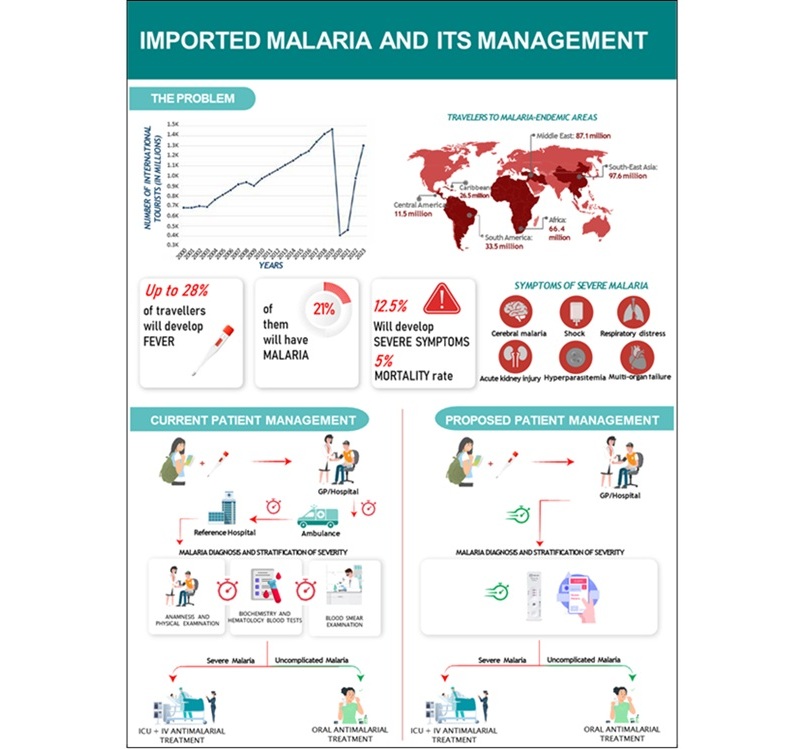
Using laboratory immunoassays and rapid tests, the team compared the performance of PfHRP2 and pan-pLDH for malaria diagnosis and severity prediction. PfHRP2 proved highly accurate for confirming infection, particularly for P. falciparum. In contrast, pan-pLDH showed strong potential to identify patients at risk of severe malaria, even when measured with simple rapid tests.
The study, published in Biosensors and Bioelectronics, demonstrated that smartphone-based video analysis could reliably quantify these biomarkers. This allowed the researchers to distinguish not only infected from non-infected individuals, but also patients more likely to progress to severe disease.
So far, the strategy has been validated in non-endemic settings, where malaria is rare but often severe and diagnostic resources are concentrated in specialized centers. The researchers believe the approach could eventually be adapted for endemic regions as well, given its low cost, speed, and reliance on widely available mobile phone technology.
However, further validation will be needed to account for epidemiological and clinical differences in those settings. The team is now working to confirm the findings in larger patient cohorts and real-world clinical environments. Their goal is for smartphone-assisted rapid tests to become a routine tool for early identification and risk stratification of imported malaria cases.