Tumor Signals in Saliva and Blood Enable Non-Invasive Monitoring of Head and Neck Cancer
Posted on 16 Dec 2025
Head and neck cancers are among the most aggressive malignancies worldwide, with nearly 900,000 new cases diagnosed each year. Monitoring these cancers for recurrence or relapse typically relies on tissue biopsies, which are painful, invasive, and not well-suited for repeated follow-up. This creates a major clinical challenge, particularly for long-term surveillance and early detection of relapse. Now, a new study has shown that molecular signals linked to tumor activity can be captured from simple saliva and blood samples, offering a non-invasive alternative to repeated biopsies.
In the study conducted at Griffith University (Queensland, Australia), researchers demonstrated that tumor-related molecular signatures can be reliably detected in small extracellular vesicles found in plasma and saliva, closely reflecting the biological profile of head and neck tumors. The study focused on small extracellular vesicles, nanoscale particles released by cells that carry proteins and other molecular cargo linked to cellular behavior.
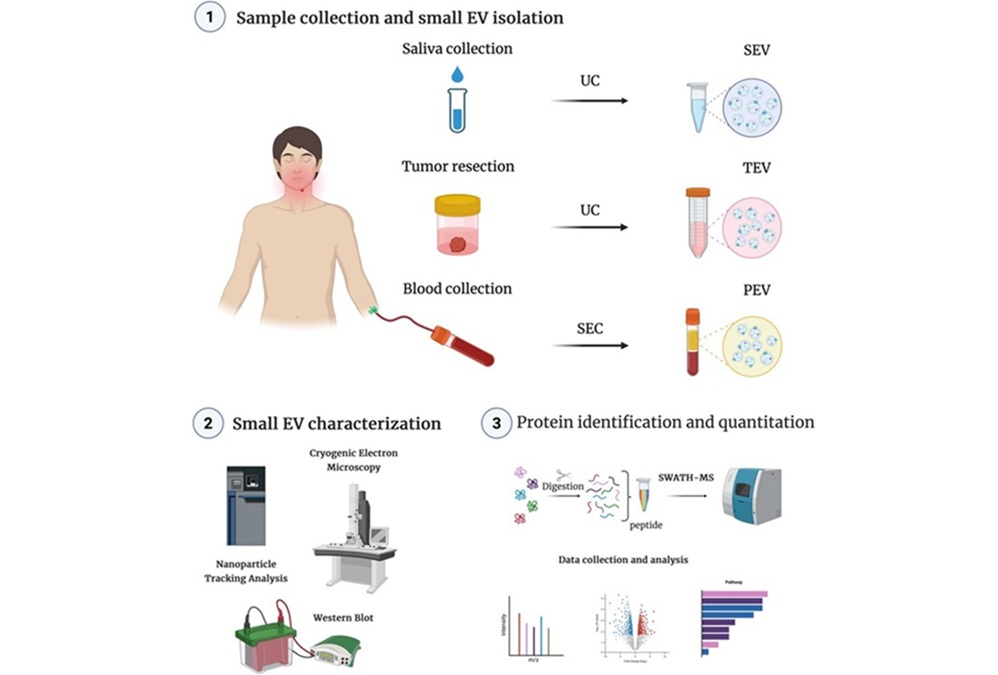
Investigators examined whether vesicles isolated from patient plasma and saliva mirrored those released directly by tumor tissue. By comparing tumor-derived vesicles with those isolated from biofluids, the team analyzed overlap in protein cargo and functional relevance. They found substantial similarity between tumor vesicles and those in saliva and plasma, indicating that biofluids capture key aspects of tumor biology.
This approach allows tumor monitoring without direct access to tumor tissue. The findings, published in the journal View, showed that more than 60 percent of identified proteins were shared across tumor, plasma, and saliva vesicles. Several of these proteins are known to play roles in tumor progression, immune system modulation, and extracellular matrix remodeling. Their consistent presence across all sample types highlights their diagnostic and biological significance.
These results suggest that saliva and blood-based vesicle analysis could be used for early detection of recurrence, longitudinal disease monitoring, and biomarker-driven treatment decisions. This non-invasive strategy could enable more frequent testing, earlier clinical intervention, and improved personalization of care for patients with head and neck cancers.
Future work will focus on refining extracellular vesicle–based biomarker panels and validating their clinical utility in larger patient cohorts. Researchers also plan to study the functional roles of the overlapping proteins to better understand how they contribute to tumor progression and metastasis.
“This study lays the groundwork for developing clinically applicable EV-based biomarker panels which can be used in routine diagnostic testing,” said Research Fellow Abolfazl Jangholi, first author of the study. “By investigating the functional roles of the overlapping proteins, we can uncover how these molecules contribute to tumor progression and metastasis.”
Related Links:
Griffith University