Artificial Intelligence Model Could Accelerate Rare Disease Diagnosis
Posted on 11 Dec 2025
Identifying which genetic variants actually cause disease remains one of the biggest challenges in genomic medicine. Each person carries tens of thousands of DNA changes, yet only a few meaningfully alter protein function in ways that lead to illness. Traditional methods can take years to pinpoint the harmful variant, leaving many patients with rare diseases undiagnosed. Now, researchers have developed an artificial intelligence (AI) model that ranks variants by their likelihood of causing disease, offering a clearer, prioritized roadmap for clinicians.
The tool, called popEVE, was developed by researchers at Harvard Medical School (Boston, MA) along with collaborators, and assigns each genetic variant a severity score calibrated across all genes, enabling clinicians to quickly identify which variants most likely explain a patient’s symptoms. By integrating evolutionary insights, protein language modeling, and human population genetics, the model unifies information previously scattered across independent tools. In a paper published in Nature Genetics, the researchers showed that popEVE could distinguish pathogenic from benign variants, flag which alterations lead to childhood versus adult-onset disease, and identify whether a variant was inherited or randomly occurred — all without ancestry bias.
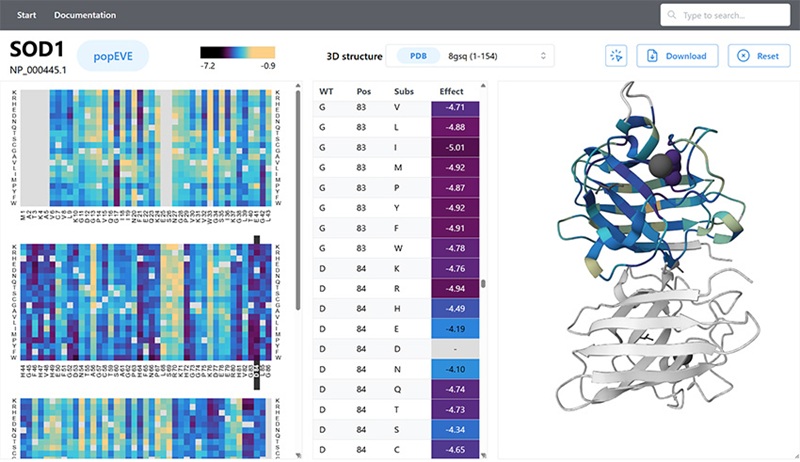
Researchers validated the model using documented case studies and then applied it to about 30,000 patients with severe developmental disorders lacking a diagnosis. popEVE provided diagnostic insights in roughly one-third of cases and identified 123 gene variants linked to developmental disorders that had not been previously associated with disease. Twenty-five of those genes have since been independently confirmed by other labs, underscoring the model’s real-world value. By revealing which variants most severely disrupt protein function and human physiology, the model offers a direct path toward diagnosis for patients who have exhausted standard testing.
popEVE expands upon an earlier model, EVE, which learned from conserved mutations across species. The new version adds a protein large-language model and human population data, allowing for cross-gene comparisons — something earlier systems struggled to achieve. This calibration enables popEVE to place all variants on the same severity scale, making it easier for clinicians to prioritize which alterations deserve immediate attention when evaluating patients with complex or unexplained conditions.
The research team is now integrating popEVE scores into public databases such as ProtVar and UniProt so clinicians and scientists worldwide can apply them in genetic evaluation and drug discovery. The model also showed strong potential for identifying new therapeutic targets by pinpointing the most functionally disruptive genetic changes. While additional validation will be required before clinical deployment, the researchers anticipate that popEVE could soon help accelerate diagnoses, reduce uncertainty, and guide precision treatments for patients with rare or single-variant genetic diseases.
“Our goal was to develop a model that ranks variants by disease severity — providing a prioritized, clinically meaningful view of a person’s genome,” said co-senior author Debora Marks. “We think prioritizing variants based on predicted disease severity will improve the odds of diagnosis and ultimately pave the way for better treatment and drug discovery.”
Related Links
Harvard Medical School
popEVE portal