New Test Distinguishes Vaccine-Induced False Positives from Active HIV Infection
Posted on 11 Dec 2025
Since HIV was identified in 1983, more than 91 million people have contracted the virus, and over 44 million have died from related causes. Today, nearly 40 million individuals worldwide live with HIV-1, the strain responsible for most infections. While vaccines are advancing, many candidates induce antibodies that can trigger false-positive HIV tests, making diagnosis and trial interpretation difficult. A new rapid approach now enables clear differentiation between true infection and vaccine-related immune responses.
Researchers at Penn State University (University Park, PA, USA) have developed a point-of-care device that detects both HIV-related proteins and viral RNA to distinguish active infection from vaccine-induced seroreactivity. In collaboration with the HIV Vaccine Trials Network, researchers tested 104 human samples using a 3D-printed diagnostic platform engineered to filter plasma through microchannels and across two test strips simultaneously. One strip detects protein biomarkers generated by antibodies; the other identifies HIV-1 RNA, indicating true viral replication.
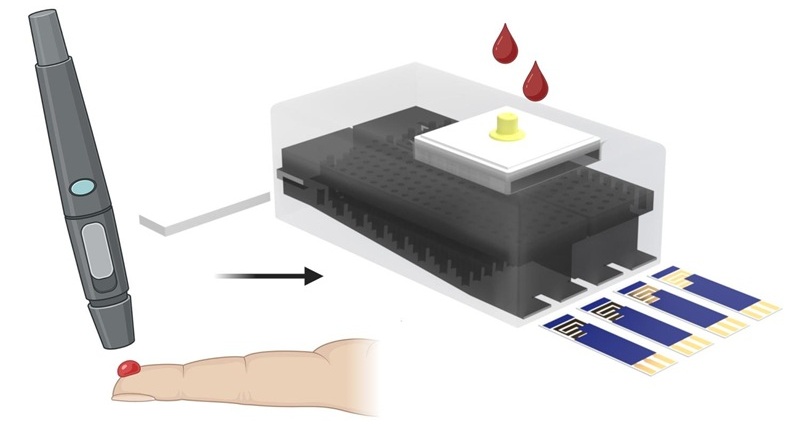
The validation, published in Science Advances, showed 95% accuracy in identifying active HIV-1 infection and 98% accuracy in ruling out cases in which vaccine-related immune responses produce false positives. The device’s dual-marker approach outperformed or matched current methods while operating in just five minutes. By incorporating nucleic acid detection, the platform avoids a major limitation of antibody-based diagnostics: the inability to reliably differentiate vaccine effects from true infection.
This technology could support future vaccine trials by minimizing diagnostic uncertainty, simplifying clinical workflows, and improving participant recruitment. Beyond research settings, its scalable and low-cost design carries potential for global deployment, particularly in areas where confirmatory molecular testing is limited. The team plans to enhance device durability, expand its pathogen-screening capability, and explore an at-home viral load testing format for patients receiving antiretroviral therapy.
“By incorporating HIV-1 RNA detection, the testing platform provides a definitive indicator of active viral replication, allowing accurate discrimination between vaccine-induced responses and true infection,” said Dipanjan Pan, PhD, senior author of the study. “Our proposed all-in-one testing platform represents a substantial advancement in HIV diagnostics, enabling accurate detection of active HIV infection while minimizing false positives due to VISP. The scalable design and relatively low cost of the device make it an appealing solution for widespread adoption in both resource-rich and resource-limited environments.”
Related Links:
Penn State University