Label-Free Microscopy Methodd Enables Faster, Quantitative Detection of Malaria
Posted on 23 Apr 2026
Microscopy of blood smears remains a cornerstone for malaria diagnosis but can be slow, stain-dependent, and operator intensive. With more than 200 million infections and over 600,000 deaths annually, faster and more objective readouts could improve testing workflows and surveillance. Aligning results across laboratories is also challenging when interpretation is subjective. To address this, researchers have introduced a microscopy approach that combines a magnetic field with polarized light to provide quantitative measurements, enabling faster and more objective detection of malaria in blood.
The team, comprising researcher Dickson Mwenda Kinyua of Kirinyaga University in Kenya and Pietro Cicuta with his team at the University of Cambridge, developed a magneto-optical microscopy platform that combines a controlled magnetic field with polarized light to visualize and quantify malaria pigment (hemozoin) in blood. The method is designed to generate objective measurements without the need for staining or chemical treatment and is described in a study in Biomedical Optics Express (2026).
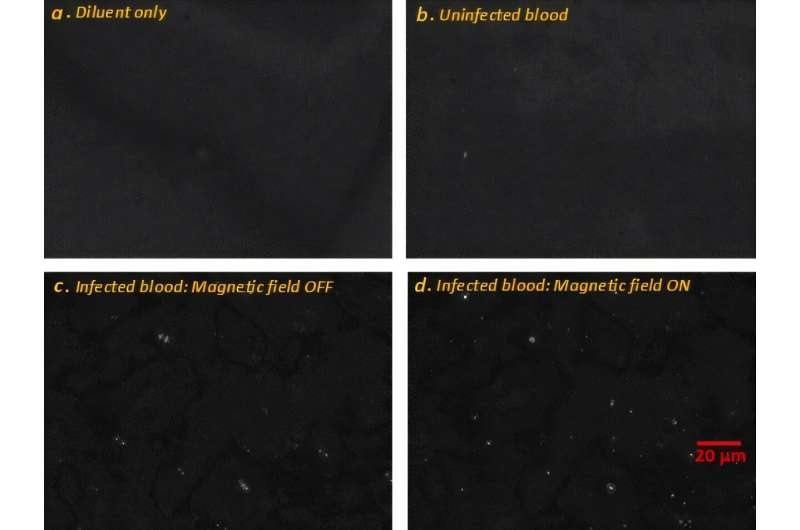
The platform exploits physical properties of hemozoin, which is produced when parasites digest hemoglobin inside red blood cells (RBCs). These crystals are magnetically anisotropic and exhibit optical dichroism, meaning they align in a magnetic field and modulate polarized light in an orientation-dependent manner. Under a polarizing microscope, applying the magnetic field induces measurable intensity and contrast shifts. Ratiometric intensity analysis, which compares image intensity before and after magnetic alignment, combined with threshold-based segmentation, links signal strength to hemozoin concentration and enables quantitative readouts.
Laboratory imaging of blood samples with and without malaria produced a consistent signal that increased linearly with hemozoin content, indicating reliable detection and quantification. The team plans to move from controlled experiments to clinical trials, expand testing across a wider range of patient samples, and compare performance with standard methods. Ongoing work targets simpler, faster operation and integration with image analysis and machine learning to reduce expert dependence and improve consistency.
“Our method not only makes it possible to see malaria but also allows more precise measurements and the potential to map its location in the sample. This quantitative information could be very useful in laboratories and hospitals, where it could provide a faster, more consistent, and sensitive diagnosis. It could also make it possible to develop automated approaches for diagnosis,” said Dickson Mwenda Kinyua, researcher at Kirinyaga University in Kenya.
“Our method doesn't require expert interpretation and works without needing to stain or chemically treat the sample, making testing more accessible and easier to perform consistently,” said Kinyua. "This could lead to earlier detection, better treatment decisions, and ultimately better health outcomes"
Related Links
Kirinyaga University