Interpretable AI Reveals Hidden Cellular Features from Microscopy Images
Posted on 25 Apr 2026
Microscopy images contain rich clues about cell health, but many disease-relevant morphological differences are too subtle to see and difficult to quantify consistently. Artificial intelligence (AI) has helped, yet many models function as opaque “black boxes,” limiting trust and reproducibility in clinical workflows. More transparent tools that expose which visual features drive decisions could accelerate reliable single‑cell phenotyping. A new study shows an interpretable AI framework that learns reusable morphological features from cell images to better characterize cellular states.
At The University of Hong Kong (HKU), researchers developed MorphoGenie, an AI framework designed to analyze individual-cell images and reveal subtle but meaningful patterns linked to identity, state, and behavior. Unlike conventional models, MorphoGenie is built for interpretability, enabling users to see which image features underpin each prediction. The system learns a compact set of reusable “building blocks”—including cell size and shape, broad internal texture, and fine local details—and recombines them to describe diverse cellular conditions.
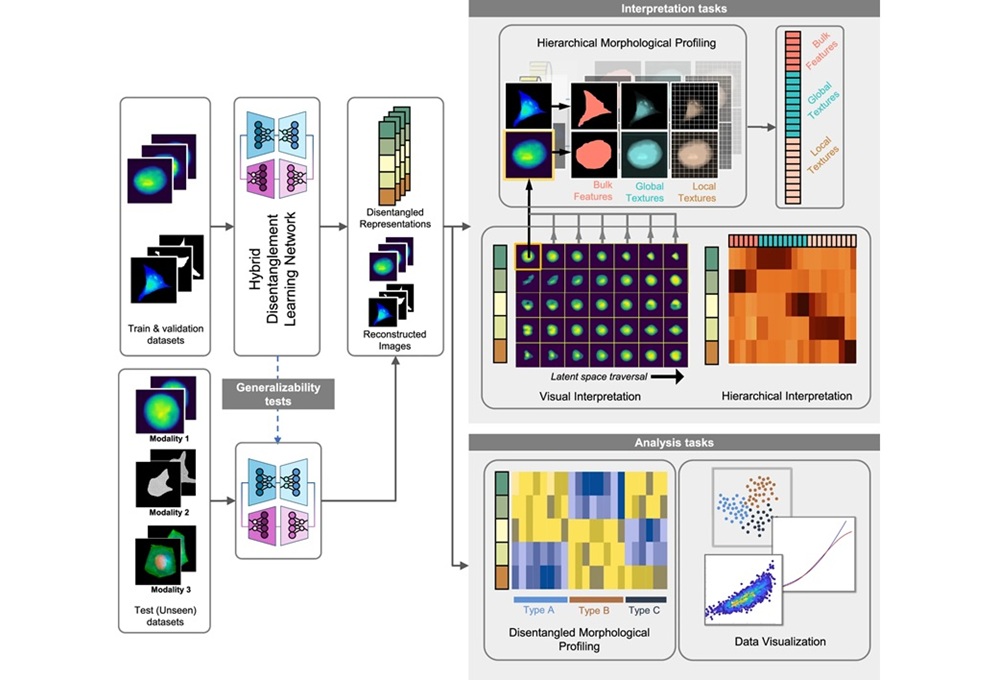
MorphoGenie applies the AI principle of compositionality to cell morphology, learning concepts directly from images rather than relying on manual labels or hand‑crafted features. The framework organizes complex image information into a concise, human-understandable representation. It functions across multiple microscopy modalities, including label‑free quantitative phase imaging and fluorescence microscopy, and can transfer learned features from one dataset to previously unseen datasets.
In demonstrations, the HKU team showed that MorphoGenie distinguished major lung cancer cell subtypes, detected drug‑induced morphological changes, and tracked dynamic processes such as cell‑cycle progression and epithelial‑to‑mesenchymal transition. The work is published in Nature Communications. The approach is positioned to support more transparent analyses in biomedicine, where trust, reproducibility, and scientific insight are essential.
“One of the long-term goals of AI is to build systems that learn from reusable concepts, rather than simply memorizing patterns. Humans do this naturally—we understand the world by combining simple ideas into more complex ones. MorphoGenie applies a similar principle to cell morphology, helping to make AI more transparent, adaptable and potentially more useful for future disease diagnostics,” said Professor Kevin Tsia, Department of Electrical and Computer Engineering and Program Director of the Biomedical Engineering Program, The University of Hong Kong.
"Cell images contain much richer information than what we can easily describe using conventional measurements alone," said Dr. Rashmi Sreeramachandra Murthy, the first author of the study. "By learning interpretable visual primitives, MorphoGenie helps reveal meaningful biological patterns that might otherwise remain hidden, while still allowing researchers to understand what the AI is using to interpret the data."
Related Links
University of Hong Kong