Immunoassay Biomarkers Evaluated for Preeclampsia Diagnosis
By LabMedica International staff writers
Posted on 17 Aug 2017
Preeclampsia is one of the leading hypertensive disorders in pregnant women worldwide and it is estimated to cause more than 60,000 deaths per year. Preeclampsia is induced by placental and maternal vascular dysfunction, which affects both maternal and neonatal health.Posted on 17 Aug 2017
The current diagnosis of preeclampsia is based on non-specific tests such as new onset of hypertension and proteinuria after 20 weeks of gestation. More recently, two emerging biomarkers, anti-angiogenic factor soluble fms-like tyrosine kinase 1 (sFlt-1) and pro-angiogenic factor placental growth factor (PlGF), have been demonstrated to be involved in the pathophysiology of preeclampsia.
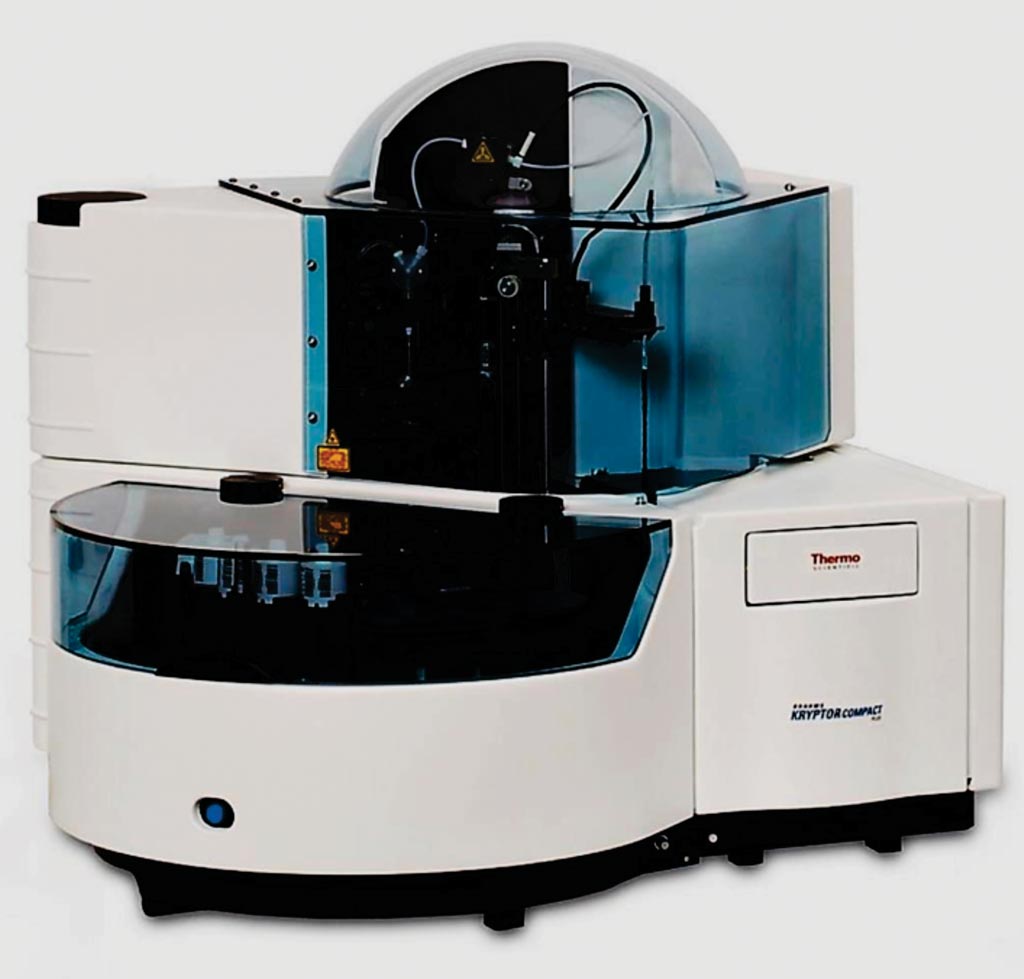
Image: The Brahms Kryptor automated immunoassay platform (Photo courtesy of Thermo Fisher Scientific).
Scientists at the University of Chicago, Chicago, IL, USA) and their colleagues examined K2-EDTA plasma samples from 50 patients on, an automated immunoassay platform. Quality control (QC) materials were used to access intra- and inter-precision of the assay. Lower limit of quantitation and interference studies were determined using pooled patient plasma. Studies have shown that the usefulness of sFlt-1/PlGF ratio in confirming or ruling out suspected preeclampsia cases. Thus wider availability of the automated measurement of sFlt-1 and PlGF has the potential of improving the clinical management of preeclampsia.
The team used the Brahms Kryptor automated immunoassay platform (BRAHMS, Thermo Fisher Scientific, Waltham, MA, USA) and demonstrated an analytical measuring range for sFlt-1 and PlGF assays of 90-69,000 pg/mL and 11-7,000 pg/mL, respectively. The lower limit of quantitation (20% CV) was interpolated to be 35 pg/mL for sFlt-1 and 10 pg/mL for PlGF. Total precision for both assay displayed CVs of less than 10%. Interference studies showed that both assays were not significantly affected by hemolysis up to an H-index of 1100 for sFlt-1 and 300 for PlGF; L- and I- index of 800 and 80 respectively for both assays. When compared to another institute’s method the larger differences in overall bias based on individual tests however was greatly improved when a ratio of sFlt/PlGF is taken into account for method comparison.
The authors concluded that the pre-eclamptic biomarkers, sFlt-1 and PlGF assayed on the Brahms Kryptor platform, demonstrate good analytical performance and are acceptable for clinical studies defining the role of these biomarkers for preeclampsia. The study was presented at the 69th Annual meeting of American Association for Clinical Chemistry held August 1–3, 2017, in San Diego, CA, USA.




Platinum Member

Automated Coagulation Analyzer
Hemolumi H6
Gold Member

Fully-auto Specific Protein (Nephelometry) Analyzer
PA240

All-in-One Molecular System
AIO M160
Platinum Member
Integrated Biochemical & Immunological System
Biolumi CX Solution X10+C10