Effectiveness of PD-L1 Tests Compared for Non-Small-Cell Lung Cancer
By LabMedica International staff writers
Posted on 04 Oct 2016
In a recent study, clinical researchers compared performance of the 4 available assays for the tumor-promoting protein PD-L1 as a biomarker for assessing non-small cell lung cancer (NSCLC). They found that one assay failed to result in comparable levels of PD-L1, while the three other assays resulted in comparable levels.Posted on 04 Oct 2016
The assays are used to test expression of PD-L1 on a patient’s tumor to help customize treatment options using drugs that may be more effective against lung cancer than chemotherapy. Findings of the new study were presented September 26, 2016, by researchers from Yale Cancer Center (New Haven, CT, USA) at the International Association for the Study of Lung Cancer (IASLC) 2016 Chicago Multidisciplinary Symposium in Thoracic Oncology (Chicago, USA). The study was sponsored by Bristol Myers Squibb with the National Comprehensive Cancer Network (NCCN) Oncology Research Program.
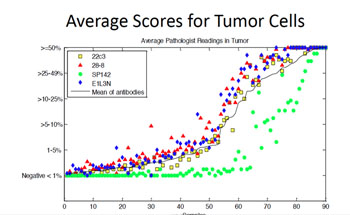
Image: Average scores for tumor cells in study comparing results of four available PD-L1 assays used by pathologists in assessing non-small cell lung cancer tumors (Image courtesy of David Rimm Laboratory / Yale Cancer Center).
The team reviewed 90 surgically resected NSCLC cases (stages I-III) and sent a sample of each to four facilities for staining. A group of 13 pathologists at 7 institutions then reviewed the samples, using 4 different assays on each case, and scored them using a unified scoring system. A comprehensive statistical analysis was then performed on the scores collected.
Currently available are four drugs with four PD-L1 assays: 22c3, 28-8, E1L3N, and SP142. However only the 22c3 test is required by the US Food & Drug Administration (FDA) for prescription of a targeted anti-PD-1 drug (pembrolizumab), while the other tests are not yet required for prescription of other PD-1 axis drugs. The study revealed that SP142 systematically returned statistically lower levels of PD-L1 expression than the other three tests. This was true in both tumor and immune cells using any test. The other three available assays (28-8, E1L3N, and 22c3) showed no significant difference between them.
“Our data shows that the SP142 assay shows significantly lower levels of PD-L1 expression. This observation may limit the use of this assay in PD-L1 testing moving forward,” said first author David L. Rimm, MD, PhD, professor at Yale School of Medicine, “However, the other three assays seem equivalent, which is good news for the future when other PD-1 axis drugs with assay-specific diagnostics gain FDA approval.”
Related Links:
Yale Cancer Center




Platinum Member

Automated Coagulation Analyzer
Hemolumi H6
Gold Member

Electrolyte Analyzer
CBS-4000 (CBS-400)
New

Fully Automated Urinalysis System
DxU 1800 Fully Automated Urinalysis System

New

Gastrointestinal Panel
Xpert® GI Panel