Smart Palm-size Optofluidic Hematology Analyzer Enables POCT of Patients’ Blood Cells
Posted on 17 Jan 2024
Variations in blood cell concentration can be indicative of several health conditions, including infections, inflammatory diseases, malignant blood disorders, and AIDS (Acquired Immune Deficiency Syndrome). Detecting these variations is crucial for diagnosing, treating, and managing these diseases. Traditional methods for measuring blood cell concentration, like using a hemocytometer, typically require an optical microscope. Alternatively, flow cytometers offer a more efficient method for sorting and counting blood cells in fluids, but they are often large and complex, weighing between 9-30 kg, thus limiting their use to laboratory and hospital settings. This restricts the availability of point-of-care testing (POCT) and can delay treatment for patients. Now, a proposed portable smart blood cell analyzer could help overcome the limitations of conventional methods for blood cell concentration detection.
Developed by the Harbin Institute of Technology (HIT, Heilongjiang, China), this innovative analyzer integrates a miniature fluorescence microscope, typically used in neuroscience and behavioral research, with a microfluidic platform. This design significantly reduces the analyzer's size and weight, resulting in a device that measures 35 × 30 × 80 mm and weighs only 39 g, making it substantially lighter than conventional flow cytometers. The analyzer combines image processing with leukocyte counting algorithms to enhance leukocyte information and accurately determine their concentration.
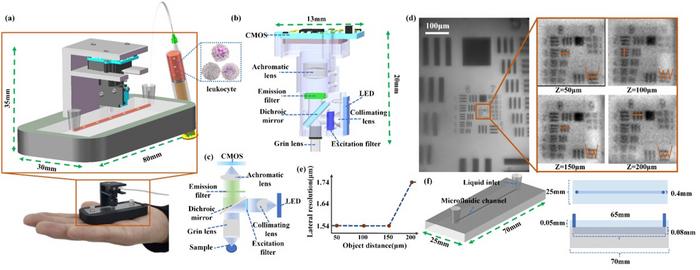
The effectiveness of the proposed analyzer was validated by comparing its leukocyte concentration measurements with those of a standard hemocytometer using Passing-Bablok analysis, achieving a correlation coefficient of 0.979. A Bland-Altman analysis further confirmed the analyzer’s reliability, establishing a 95% limit of agreement ranging from -0.93×10³ to 0.94×10³ cells/μL. The analyzer's error rate in calculating leukocyte concentration was found to be less than 10%, meeting the accuracy standards set by both the UK National External Quality Assessment Service (NEQAS) and the Clinical Laboratory Improvement Amendments of 1988 (CLIA-88). The development of this palm-size optofluidic hematology analyzer is expected to facilitate the POCT of blood cells outside traditional hospital or laboratory settings, thus enhancing medical diagnosis in remote or underserved areas.
Related Links:
HIT