Successful Cardiac Repair Depends on Maturity of Transplanted Stem Cells
By LabMedica International staff writers
Posted on 19 Jan 2016
A team of Japanese cells biologists has shown that the likelihood of stem cell therapy successfully repairing damaged heart muscle depends to large extent on the maturity of the stem cells at the time they are transplanted into the damaged organ.Posted on 19 Jan 2016
Although transplantation of induced pluripotent stem cell (iPSC)-derived cardiomyocytes (CMs) has been reported in several animal models, the treatment effect was limited, probably due to poor optimization of the injected cells.
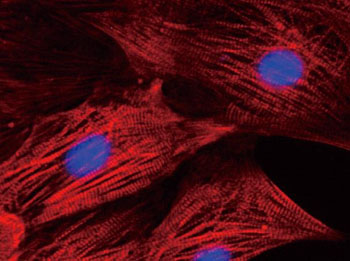
Image: Micrograph of normal heart cells (cardiomyocytes). Nuclei are shown in blue (Photo courtesy of Yoshida Laboratory, Kyoto University).
To better optimize CMs for transplantation, investigators at Kyoto University (Japan) used in vivo bioluminescence imaging to compare the engraftment efficiency of intramyocardially-injected undifferentiated-iPSCs, day four mesodermal cells, and purified iPSC-CMs 8 days, 20 days, and 30 days after initial differentiation.
They reported in the January 8, 2016, online edition of the journal Scientific Reports that the engraftment efficiency of day 20 CMs was significantly higher compared to other cell populations. Transplantation of day 20 CMs into the infarcted hearts of immunodeficient mice showed good engraftment, and echocardiography showed significant functional improvement by cell therapy. Moreover, the imaging signal at three months post injection indicated engrafted CMs proliferated in the host heart. These results suggested that day 20 CMs had very high engraftment, proliferation, and therapeutic potential in host mouse hearts.
"Cells of different maturation will be mixed and transplanted together, but heart cells at different stages could behave very differently," said first author Dr. Shunsuke Fukakoshi. "We need to test animals bigger than mice."
Related Links:
Kyoto University




Platinum Member

Automated Coagulation Analyzer
Hemolumi H6

Manual Pipetting Aid
Pipette Controllers macro
Gold Member

Neonatal Heel Incision Device
Tenderfoot