FDA-Cleared Digital Pathology Platform Expands Interoperability for Primary Diagnosis
Posted on 10 Aug 2026
Rising cancer incidence is colliding with a shrinking pathologist workforce, intensifying pressure on diagnostic turnaround times in clinical laboratories. Many labs are adopting digital pathology to manage case volume, yet long-term interoperability with scanners, image formats, and displays can limit scalability. A newly cleared platform addresses this scalability challenge by using a planned update framework to expand compatibility while remaining under FDA oversight.
Concentriq AP-Dx from Proscia (Philadelphia, PA, USA) is a digital pathology platform designed for primary diagnosis across laboratories of varying sizes. The U.S. Food and Drug Administration (FDA) has granted a new 510(k) clearance that adds compatibility with the Leica Aperio GT 450 DX slide scanner, enables cloud deployment, and authorizes a Predetermined Change Control Plan (PCCP). Together, these updates are intended to strengthen the platform’s role as an interoperable hub for routine diagnostic workflows.
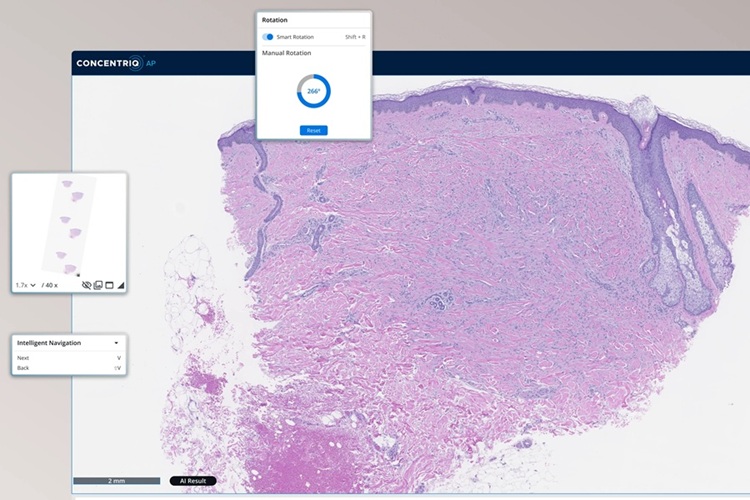
Under the authorized PCCP, Proscia can validate and implement support for additional FDA-cleared scanners, image formats, and displays without submitting a new 510(k) notification for each change, while maintaining regulatory oversight. The approach is designed to streamline interoperability updates, helping laboratories scale digital pathology operations and reduce dependence on proprietary ecosystems. According to the company, laboratories are increasingly adopting digital pathology to manage rising diagnostic demand and unlock additional operational and clinical value.
Concentriq AP-Dx initially received FDA 510(k) clearance for primary diagnosis with the Hamamatsu NanoZoomer S360MD Slide scanner in February 2024 and is also CE-marked under the In Vitro Diagnostic Regulation (IVDR). In KLAS Research’s 2026 Digital Pathology report on the U.S. market, Proscia received the highest score for supporting customers’ integration goals as well as the top overall performance score. The company also reports that its technology supports diagnostic laboratories managing approximately 12 million patient cases annually.
“Laboratories choose a digital pathology platform with the expectation that it will sit at the center of their practice for years to come. The PCCP helps us to protect that investment, giving customers confidence that Concentriq AP-Dx will continue to be an interoperable foundation as their needs evolve,” said Ian Cadieux, Head of Quality and Regulatory at Proscia.
Related Links
Proscia