Combined Blood Tests Help Clarify Colorectal Cancer Recurrence Risk
Posted on 12 Nov 2026
Colorectal cancer is the third most common cancer worldwide and the second leading cause of cancer-related mortality. For patients undergoing curative-intent surgery for metastatic disease, predicting recurrence remains challenging, and the value of perioperative molecular testing is uncertain. A new study suggests that combining preoperative blood-based genomic profiling with postoperative molecular residual disease testing may improve risk stratification, identifying groups with estimated two-year recurrence-free survival rates ranging from 78% to 9%.
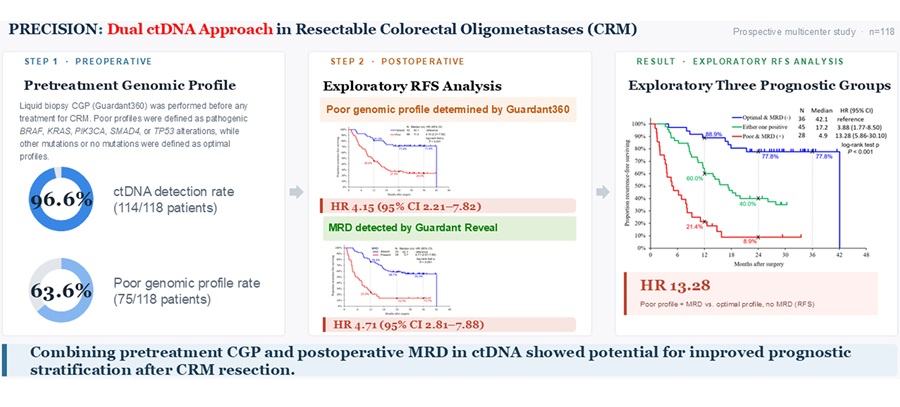
The PRECISION study evaluated Guardant360 Liquid and Guardant Reveal in 130 patients enrolled in a prospective, multicenter observational study in Japan. Guardant360 Liquid was used for comprehensive genomic profiling before treatment, while Guardant Reveal assessed molecular residual disease approximately four weeks after surgery. By combining pretreatment tumor mutation profiling with postoperative circulating tumor DNA detection, the tests aimed to improve recurrence risk stratification.
Guardant360 Liquid is a blood-based test that analyzes tumor DNA fragments circulating in the blood, or cell-free DNA, to identify genetic mutations in advanced solid tumors. Guardant Reveal is a tissue-free liquid biopsy test that detects molecular residual disease and monitors recurrence in early-stage colorectal, breast, and lung cancers. The paired approach is relevant because tissue-based testing is often infeasible due to limited biopsy accessibility before treatment and longer turnaround times after surgery.
Pretreatment blood-based profiling was feasible in nearly all eligible patients, with Guardant360 Liquid detecting genomic alterations in 97% of patients. Among these patients, 64% had genomic profiles associated with a greater than four-fold higher hazard of recurrence or death. Postoperative molecular residual disease testing was evaluable in 99% of patients who underwent surgery, and molecular residual disease was detected in 31%, with a 4.7-fold increase in hazard of recurrence or death.
Combining pretreatment genomic profiling with postoperative molecular residual disease testing identified three risk groups. Estimated two-year recurrence-free survival was 78% among patients with neither adverse feature, 40% among those with one, and 9% among those with both. The findings indicate the potential of a dual circulating tumor DNA approach to identify biomarkers and inform development of personalized perioperative chemotherapy for advanced stages of colorectal cancer.
“The application of ctDNA analysis has evolved dramatically in this decade. However, the clinical utility of preoperative CGP and postoperative MRD testing for guiding perioperative treatment decisions for resectable colorectal oligometastases (CRM) has been unclear,” said Shin Kobayashi, MD, PhD, Department of Hepatobiliary and Pancreatic Surgery, National Cancer Center Hospital East, Kashiwa, Japan, a principal investigator of the PRECISION study.
“PRECISION suggests that combining pretreatment tumor genomic profiling with postoperative MRD assessment may provide complementary prognostic information. This could help patients and their care teams better understand the post-surgery risk of recurrence and inform the future development of more personalized treatment strategies, although these findings should be prospectively verified in an interventional study,” said Dr. Kobayashi.
Related Links
Guardant Health