Microneedles Detect Real-Time Chemical Changes in the Body
By LabMedica International staff writers
Posted on 19 Jan 2012
A new technology uses microneedles to allow doctors to detect real-time chemical changes in the body--and to do so continuously for an extended period of time.Posted on 19 Jan 2012
Microneedles are very small needles in which at least one dimension--such as length--is less than one millimeter. The hollow channels within microneedles are loaded with electrochemical sensors that can be used to detect specific molecules or pH levels.
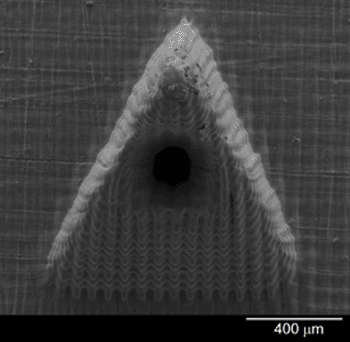
Image: Scanning electron micrograph (SEM) of a hollow microneedle. In this study, hollow microneedles were integrated with sensors for detection of glucose, lactate, and pH levels (Photo courtesy of North Carolina State University).
The scientists developed a proof-of-concept sensor array incorporating three types of sensors, which could measure pH, glucose, and lactate. However, Prof. Narayan says the array could be modified to monitor a wide variety of chemicals.
"The idea is that customized microneedle sensor arrays could be developed and incorporated into wearable devices, such as something like a wristwatch, to help answer specific medical or research questions," added Prof. Narayan. "It's also worth pointing out that microneedles are not painful."
The technology was developed by scientists from North Carolina State University (Raleigh, NC, USA), Sandia National Laboratories (Albuquerque, NM, USA), and the University of California, San Diego (CA, USA).
The microneedles were described online in the November 2011 edition of the journal Talanta.
Related Links:
NC State's College of Engineering
University of North Carolina at Chapel Hill
Sandia National Laboratories



Gold Member

Neonatal Heel Incision Device
Tenderfoot


Hematology Consumables
Bioblood Devices

Steam Sterilizer
Hi Vac II Line