AI Model Enables Personalized Glucose Predictions for Type 1 Diabetes
Posted on 19 Mar 2026
Type 1 diabetes (T1D) requires careful blood glucose monitoring and precise insulin dosing, as even small errors can lead to dangerous excursions. Continuous glucose monitoring (CGM) provides real-time data for prediction, but physiologic differences between users and limited adaptability for new users remain challenges. Many existing algorithms focus on either short- or long-term patterns, overlooking complementary dynamics and reducing consistency across ages and daily routines. Researchers have now developed a machine-learning model to improve individual glucose forecasting by addressing the patient-to-patient variability that has limited current tools.
Developed at Jeonbuk National University (Jeonju, South Korea), BiT‑MAML combines bidirectional long short‑term memory (LSTM) and Transformer architectures with Model‑Agnostic Meta‑Learning (MAML). The LSTM component processes continuous glucose time series bidirectionally to capture short‑term fluctuations. The Transformer, utilizing a multi‑head attention, models longer‑range, lifestyle‑linked cycles, while meta‑learning accelerates personalization from limited data.
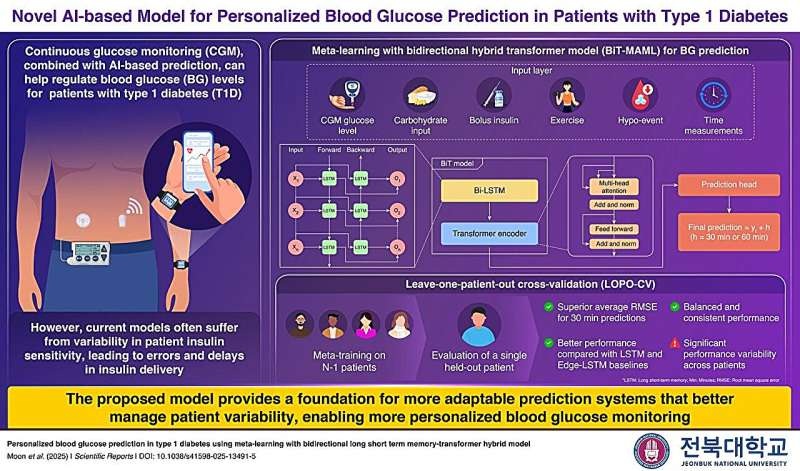
Performance was assessed using leave‑one‑patient‑out cross‑validation, training on multiple patients and testing on an unseen case. Compared with conventional approaches, the model achieved significantly lower prediction errors. Absolute errors ranged from 19.64 to 30.57 milligrams per deciliter across individuals, highlighting gains over standard long short‑term memory baselines and persistent variability.
The work was published in Scientific Reports. The researchers emphasize the importance of evaluation frameworks that transparently capture variability across users. They note that combining advanced architectures with robust assessment can strengthen trust and performance in continuous glucose monitoring–based prediction for people with type 1 diabetes.
"BG dynamics are not uniform across all patients. The physiological patterns of an elderly patient are vastly different from those of a young adult," said Jaehyuk Cho, Professor in the Department of Software Engineering at Jeonbuk National University. "Addressing this challenge will contribute to the development of effective CGM models that can serve diverse patients with T1D, from children to the elderly."