LC-MS Used to Quantify Rat Poison in Humans
By Labmedica staff writers
Posted on 03 Jun 2008
Posted on 03 Jun 2008
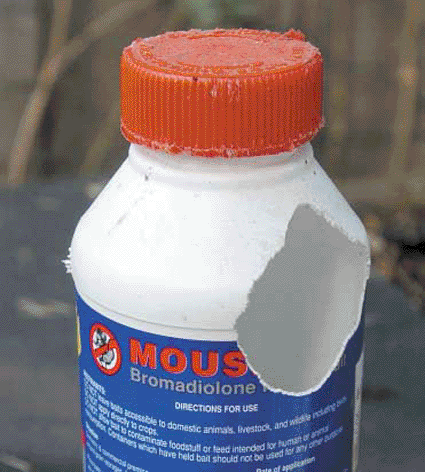
Image: Bromadiolone rodent bait, showing a chewed-through section of the container (Photo courtesy of Animal Control Technologies).
The cause of serious bleeding disturbances in a female patient was investigated during a recent poisoning case. It appeared that the woman had been exposed to blood-thinning substances. Examination of blood samples revealed that she had been repeatedly exposed to bromadiolone.
The concentrations of bromadiolone in whole blood and plasma in serial samples from the woman were measured. The half-life of bromadiolone in blood was estimated to be about six days in the initial phase of elimination and about 10–13 days in the terminal phase. The mean plasma/blood ratio of bromadiolone was 1.7 ± 0.6. Stability testing of bromadiolone in whole blood samples after two cycles of freeze and thaw revealed that bromadiolone concentrations decreased.
Poisoning with superwarfarins, such as bromadiolone, is a growing public health problem, and the mortality is high. A number of cases have been reported internationally where people have been poisoned, with a mortality rate of 20 %. Blood-thinning substances have been used for many years as rodenticides. Warfarin was previously used but due to resistance development, the super-warfarins, 100 times as potent as warfarin, were introduced. These highly potent blood-thinning agents are also used in terror attacks where they were discovered on bomb fragments and in food products. The threat from bioterror becomes greater with substances such as bromadiolone, which can be purchased freely in shops.
Few laboratories have been able to prove the presence of bromadiolone in human samples and little is known about what happens to the substance in the human body. Scientists at the Norwegian Institute of Public Health (NIPH; Oslo, Norway) developed the analysis method to spot the presence of bromadiolone.
The study was published in the May 2008 edition of the Journal of Forensic Sciences.
Related Links:
Norwegian Institute of Public Health




Platinum Member

Automated Coagulation Analyzer
Hemolumi H6

Gold Member

Neonatal Heel Incision Device
Tenderfoot

Automatic CLIA Analyzer
Shine i6000
New
Gold Member

Platelet Function Analyzer
PL-12