Cell-Free Assay Detects Functional IgE for Food Allergy Diagnosis
Posted on 18 Jul 2026
Accurately distinguishing sensitization from clinically relevant food allergy remains a challenge for laboratories, as routine blood tests detect allergen-specific immunoglobulin E (IgE) but not its capacity to trigger reactions. Functional assays can be informative yet often rely on viable cells and specialized procedures that limit routine use. Safer, mechanism-based tests that align with oral food challenge outcomes are needed to guide patient management.
Hiroshima University, together with Aichi Children’s Health and Medical Center and Shimane University, developed an improved allergen-specific IgE (sIgE) test derived from the AlphaCL method. Originally created to detect serum antibody cross-linking in patients with hives, AlphaCL was adapted to assess whether a patient’s IgE can trigger effector mechanisms relevant to allergic reactions. The modified approach evaluates allergen-induced cross-linking of IgE receptors (FcεRI) without using living cells.
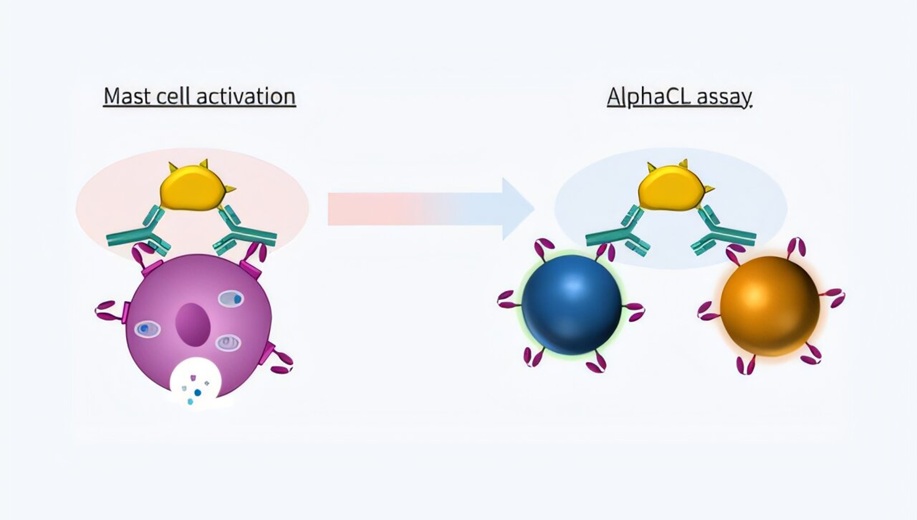
The investigators addressed a key limitation of the conventional AlphaCL assay by reducing interference from blood serum components that can obscure detection. Using modified allergens, the method facilitates removal of interfering serum constituents, allowing these components to be washed off the reaction plate before readout. In doing so, the assay measures not only the amount of IgE present but the fraction that is functionally capable of inducing allergic responses.
Performance was evaluated by comparing the improved and conventional AlphaCL assays under serum-containing conditions known to interfere with IgE detection. The modified method retained 66% of its signal observed in serum-free samples, whereas the conventional method retained 3.3%, indicating substantially stronger signal preservation. In patient testing with representative food allergens—egg, wheat, and milk—the improved assay detected allergen-sIgE in 93.3% (28 of 30) of individuals who were positive on oral food challenges, and findings suggest the approach can be adapted to a wide range of allergen targets.
The study appears in Methods (2026). The authors note that analyses included only patients with positive oral food challenge results and a limited number of cases, underscoring the need for further evaluation.
“In order for allergic reactions to occur, IgE antibodies must bind to IgE receptors (FcεRI) on effector cells such as mast cells, and cross-linking of multiple FcεRI molecules by allergens is required to trigger the response. Consequently, conventional tests may classify individuals as having food allergies … when allergen-specific IgE is present but does not lead to actual symptom development. This discrepancy between test results and clinical symptoms represents a major challenge, contributing to diagnostic uncertainty and unnecessary dietary restrictions,” said Yuki Koga, a pharmacist in the Department of Pharmaceutical Services at Hiroshima University Hospital and the primary author of the research paper.
“[Our modified] AlphaCL method allows assessment of allergen-induced FcεRI cross-linking without the use of cells. In other words, it enables evaluation not only of how much IgE is present but also of how much functionally active IgE capable of inducing allergic reactions is present, using a simple and reproducible system. This study demonstrates the feasibility of detecting functional, [allergy-inducing] IgE through a more practical and accessible approach, highlighting the methodological significance of this technique,” added Koga.
Related Links
Hiroshima University





 Assay.jpg)