Blood Biomarker May Help Monitor Early Response to Lecanemab in Alzheimer’s Disease
Posted on 16 Sep 2026
Alzheimer’s disease is a progressive neurodegenerative disorder marked by amyloid-beta and tau pathology and remains a leading cause of cognitive decline in older adults. Although lecanemab, an anti-amyloid therapy for early Alzheimer’s disease (AD), can slow progression, individual responses vary. Clinicians therefore need accessible tools to monitor biological response during treatment without relying solely on repeated positron emission tomography (PET). A new study shows that a blood-based tau biomarker may help indicate early response to lecanemab.
Korea University College of Medicine (Seoul, South Korea) researchers evaluated plasma phosphorylated tau 217 (p-tau217) as a blood-based marker to monitor biological response to lecanemab in people with early AD. The approach leverages longitudinal changes in p-tau217, a circulating biomarker associated with AD pathology, measured at baseline and during therapy. Cognitive outcomes were assessed in parallel using the Mini-Mental State Examination (MMSE) and Clinical Dementia Rating–Sum of Boxes (CDR-SB).
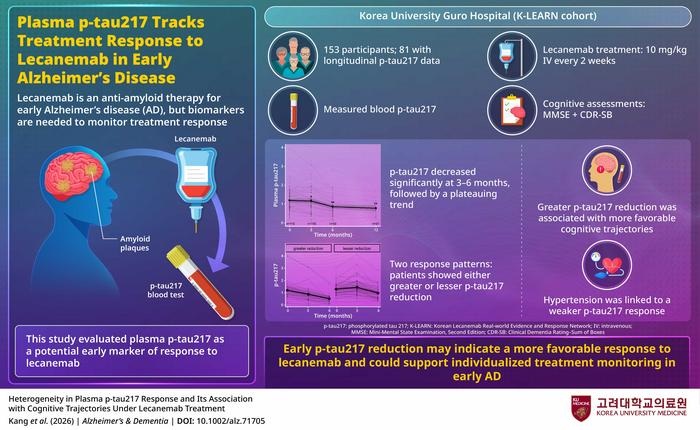
In a prospective real-world study, 153 patients receiving lecanemab were followed. Of these, 81 had complete p-tau217 measurements at baseline, three months, and six months and were included in analyses of distinct biomarker-response patterns. Cognitive assessments were tracked for 12 months.
Plasma p-tau217 levels declined significantly by three months after treatment initiation, with the largest decrease occurring between three and six months before reaching a plateau. Two response trajectories emerged: 29 patients showed greater reductions, while 52 showed smaller reductions. Patients with greater reductions had more favorable cognitive trajectories, including slower increases in CDR-SB and better MMSE outcomes. These associations remained significant after adjustment for baseline clinical and biomarker characteristics, with a statistically significant difference in CDR-SB trajectories between groups (p < 0.001).
Baseline hypertension was independently associated with a weaker p-tau217 response. Consistent with this finding, hypertension was present in 10.3% of patients in the greater-reduction group, compared with 42.3% in the lesser-reduction group.
The article was made available online on July 31, 2026, and published on August 1, 2026, in Alzheimer’s & Dementia (Volume 22, Issue 8). The authors note that repeated p-tau217 measurements could provide information about biological changes during lecanemab treatment and help identify differences in response, while emphasizing the need for larger, multicenter studies with longer follow-up to validate these patterns and define clinically meaningful thresholds.
“We found that plasma p-tau217 levels decreased significantly from 3 months after treatment initiation. The greatest decline occurred between 3 and 6 months, followed by a plateau,” said Sung Hoon Kang, Associate Professor at Korea University College of Medicine.
“As blood-based Alzheimer’s biomarkers become widely available, repeated p-tau217 testing may allow clinicians to monitor biological treatment response in a manner that is less invasive, less costly, and more accessible than repeated PET imaging,” added Dr. Kang.
Related Links
Korea University College of Medicine





.jpg)