






Surprise Source of Mild Cognitive Impairment
By Biotechdaily staff writers
Posted on 21 May 2002
A study has uncovered a surprising mechanism as the cause of mild cognitive impairment (MCI), considered to be a precursor to Alzheimer's disease (AD). Conducted by researchers at the University of Pittsburgh (UPMC, PA, USA), the study was published in the January 31,2002, issue of Annals of Neurology.Posted on 21 May 2002
The researchers found that in older people with MCI, the brain produces more choline acetyltransferase (ChAT), an enzyme important in memory and cognitive functions. This may be the result of the brain's attempt to maintain normal function as the neurons that communicate to the memory center die. Supporting this view are autopsy results showing that more than 60% of people who had MCI within a year before their death already had evidence of neurodegeneration seen in the early stages of AD.
This finding is almost the opposite of what most researchers believed, which is that a decrease--not an increase--in ChAT levels causes MCI. In fact, this has been the theory early memory changes in MCI and mild AD,” said Steven T. DeKosky, M.D., professor of behind most treatments for AD, such as drugs that boost levels of the enzyme's product, the neurotransmitter acetylcholine. Instead, it appears that drugs should be used that can slow down or stop the early stages of neurodegeneration, except in patients who actually have a deficit in ChAT. In the study, the researchers found that only people with end-stage AD had ChAT levels below normal.
"The entorhinal cortex cell loss, not the cholinergic deficit, appears responsible for the neurology, psychiatry, and neurobiology at University of Pittsburgh School of Medicine and principal investigator in the study.




Platinum Member

Automated Coagulation Analyzer
Hemolumi H6

Gold Member

Fully-auto Specific Protein (Nephelometry) Analyzer
PA240
Gold Member
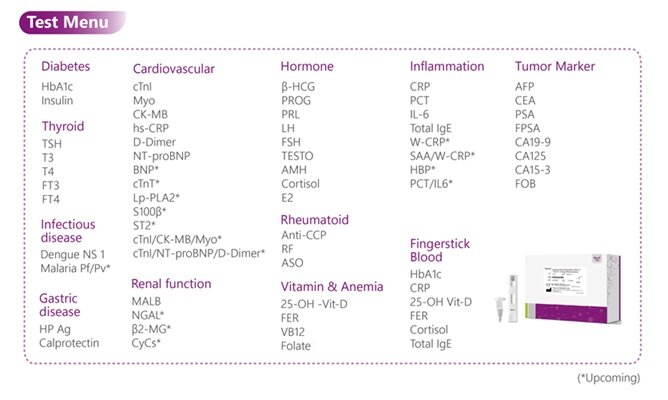
Quantitative lmmunoassay Test Menu


All-in-One Molecular System
AIO M160


