Study Reveals Diagnostic and Therapeutic Target in Rare Pancreatic Tumors
Posted on 31 Mar 2026
Insulinomas are rare tumors of the pancreas that can cause dangerous hypoglycemia, triggering dizziness, headaches, fatigue, and seizures. Surgery is often effective, yet diagnosis and management become challenging when multiple lesions are present and only some oversecrete insulin. Imaging and insulin staining verify excess insulin production but cannot reliably identify the culprit lesion. Researchers now report a molecular mechanism underlying inappropriate insulin release that could refine lesion-level diagnostics.
At Institute of Science Tokyo, investigators identified the DOCK10 gene as a key regulator of insulin hypersecretion in insulinomas. DOCK10 was strongly and specifically expressed in insulin‑secreting tumor cells but not in normal pancreatic tissue or other pancreatic tumor types. Mechanistically, DOCK10 activates a Cdc42 signaling pathway that governs insulin exocytosis, linking aberrant pathway activity to excessive hormone release.
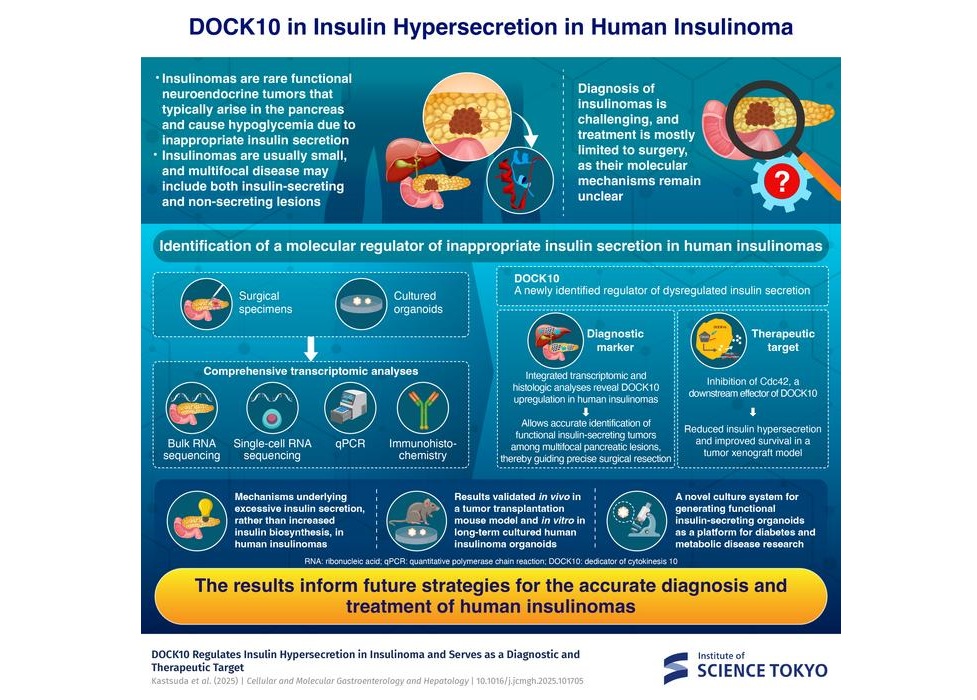
Tthe team integrated analyses of surgical insulinoma specimens with patient‑derived organoids and established a biobank of tumor samples. Large‑scale gene expression profiling—including bulk RNA sequencing, single‑cell RNA sequencing, quantitative PCR, and immunohistochemistry—showed broad alterations in genes controlling the insulin secretion machinery rather than insulin production itself. The study was published in Cellular and Molecular Gastroenterology and Hepatology.
Functional experiments demonstrated that blocking the pathway with a Cdc42 inhibitor curtailed insulin hypersecretion in insulinoma cells, in human insulinoma organoids, and in tumor models transplanted into mice; treated mice also showed improved survival. The group also developed a long‑term culture system for human insulinoma organoids that maintained consistent gene‑expression profiles with matched tissues and sustained insulin secretion over extended periods. Collaborators included the Institute of Clinical Molecular Biology at Christian‑Albrechts‑University and University Hospital Schleswig‑Holstein, Germany.
According to the authors, these findings indicate DOCK10 may serve as a diagnostic marker for insulin‑secreting lesions and a potential therapeutic target in insulinoma. The work highlights the DOCK10–Cdc42 axis as a mechanistic handle for distinguishing and modulating pathologic secretion, with implications for more accurate diagnostic techniques and targeted treatments.
"Our results suggest that DOCK10 may serve as a diagnostic marker for insulin-secreting lesions and a potential therapeutic target in insulinoma. It provides mechanistic insights that could inform future strategies for precision diagnostics and treatment of pancreatic neuroendocrine tumors," said Assistant Professor Go Ito, Department of Gastroenterology and Hepatology, Institute of Science Tokyo.
Related Links
Institute of Science Tokyo