Study Describes Use of Malaria Parasite Protein to Collect CTCs
By LabMedica International staff writers
Posted on 30 Aug 2018
A novel technique uses the malaria parasite protein VAR2CSA to bind circulating tumor cells (CTCs) from a wide variety of cancer types for collection and analysis.Posted on 30 Aug 2018
VAR2CSA (Variant Surface antigen 2-CSA), which binds specifically to the cancer cell membrane carbohydrate oncofetal chondroitin sulfate (ofCS), belongs to the Plasmodium falciparum erythrocyte membrane protein 1 (PfEMP1) family.
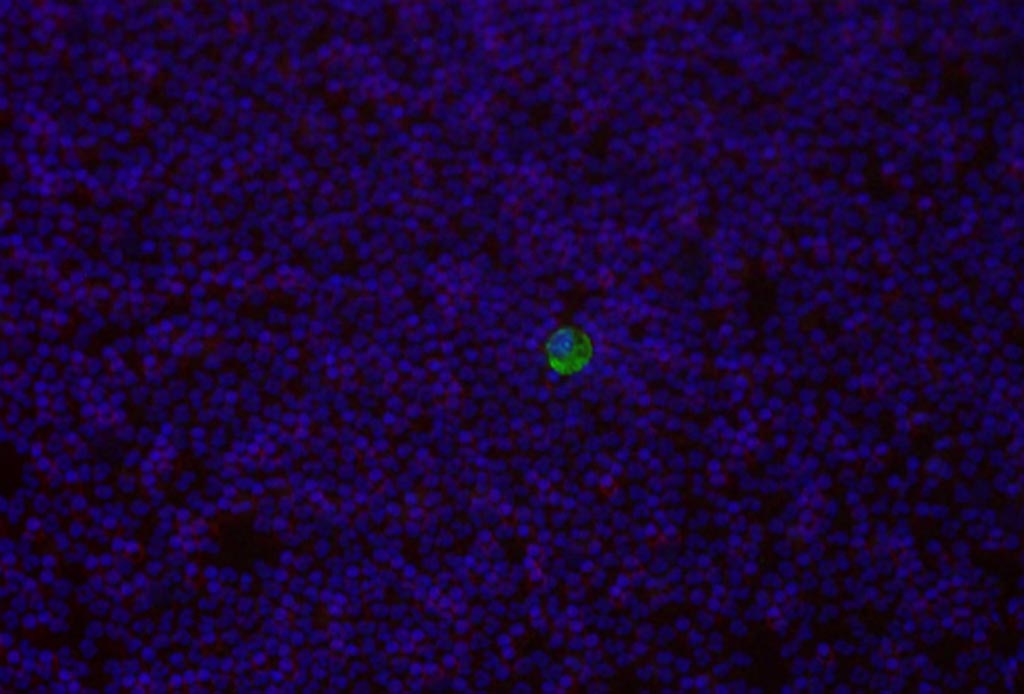
Image: A cancer cell colored with VAR2CSA (green) in a background of normal, white blood cells (red) (Photo courtesy of the University of Copenhagen Faculty of Health and Medical Sciences).
Isolation of metastatic CTCs from cancer patients is of high value for disease monitoring and molecular characterization. Despite the development of many new CTC isolation platforms in the last decade, their isolation and detection has remained a challenge due to the lack of specific and sensitive markers.
In a feasibility study published in the August 16, 2018, online edition of the journal Nature Communications, investigators at the University of Copenhagen Faculty of Health and Medical Sciences (Denmark) presented a method for CTC isolation based on the specific binding of the malaria VAR2CSA protein to the tumor marker ofCS.
The investigators reported that VAR2CSA captured CTCs efficiently from hepatic, lung, pancreatic, and prostate cancer patients with minimal contamination of peripheral blood mononuclear cells. Furthermore, in 25 stage I–IV prostate cancer patient samples, CTC enumeration significantly correlated with disease stage.
"We have developed a method where we take a blood sample and with great sensitivity and specificity, we are able to retrieve the individual cancer cells from the blood. We catch the cancer cells in greater numbers than existing methods, which offers the opportunity to detect cancer earlier and thus improve outcome. You can use this method to diagnose broadly, as it is not dependent on cancer type. We have already detected various types of cancer cells in blood samples. And if there is a cancer cell in your blood, you have a tumor somewhere in your body," said senior author Dr. Ali Salanti, professor of immunology and microbiology at the University of Copenhagen Faculty of Health and Medical Sciences.
"Today, it is difficult to determine which stage cancer is at. Our method has enabled us to detect cancer at stages one, two, three and four. Based on the number of circulating tumor cells we find in someone's blood, we will be able to determine whether it is a relatively aggressive cancer or not so then to adjust the treatment accordingly," said Dr. Salanti.
Related Links:
University of Copenhagen Faculty of Health and Medical Sciences




Platinum Member

Automated Coagulation Analyzer
Hemolumi H6
Gold Member

NEW PRODUCT : SILICONE WASHING MACHINE TRAY COVER WITH VICOLAB SILICONE NET VICOLAB®
REGISTRED 682.9
New

Drug Testing Assays
Atellica DT 250 Analyzer
Platinum Member
Integrated Biochemical & Immunological System
Biolumi CX Solution X10+C10