Novel Approach for Treating Diabetes Based on Artificial Beta Cells
By LabMedica International staff writers
Posted on 14 Nov 2017
A possible long-term approach for treating diabetes could be based on a novel type of artificial pancreatic beta cells capable of releasing insulin in response to elevated levels of glucose.Posted on 14 Nov 2017
Generating artificial pancreatic beta cells by using synthetic materials to mimic glucose-responsive insulin secretion holds promise for improving treatment in people with diabetes. Towards this end, investigators at the University of North Carolina (Chapel Hill, USA) constructed artificial beta cells (AbetaCs) with a multi-compartmental "vesicles-in-vesicle" internal structure that were equipped with a glucose-metabolism system and membrane-fusion machinery. Through a sequential cascade of glucose uptake, enzymatic oxidation, and proton efflux, the AbetaCs could effectively distinguish between high and normal glucose levels.
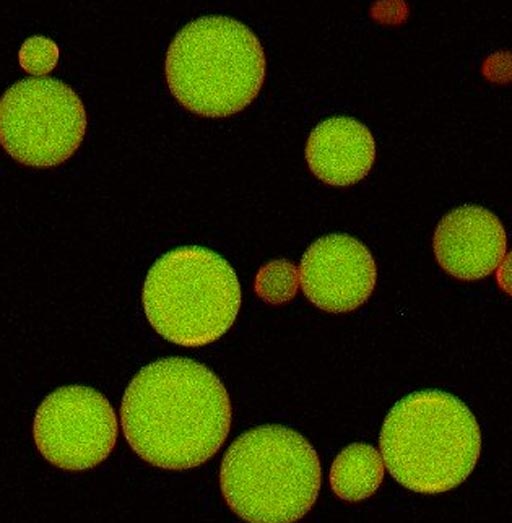
Image: An artist\'s rendition of a fluorescence microscope image of the artificial beta cells (Photo courtesy of Gu Laboratory, University of North Carolina).
The investigators reported in the October 30, 2017, online edition of the journal Nature Chemical Biology that under hyperglycemic conditions, high glucose uptake and oxidation generated an environment of low pH (below 5.6). This acidic condition induced the steric uncovering of peptides bound to the insulin-loaded inner small liposomal vesicles. The peptides on the small vesicles then interacted with complementary peptides anchored on the inner surfaces of the large vesicles, thus bringing the membranes of the inner and outer vesicles together and triggering their fusion and subsequent release of insulin.
The investigators further reported that a single injection of the AbetaCs into diabetic mice that lacked beta cells quickly normalized the animals’ blood glucose levels and kept those levels normal for up to five days. Control mice injected with AbetaCs that did not contain insulin remained hyperglycemic.
“The mice went from hyperglycemic to normoglycemic within an hour, and they remained normoglycemic for up to five days after that,” said senior author Dr. Zhen Gu, professor of medicine at the University of North Carolina “Our plan now is to further optimize and test these synthetic cells in larger animals, develop a skin patch delivery system for them, and ultimately test them in people with diabetes.”
Related Links:
University of North Carolina




Platinum Member

Automated Coagulation Analyzer
Hemolumi H6

Gold Member

Platelet Function Analyzer
PL-12
New

Slide Scanner System
NanoZoomer S540MD
Platinum Member
Integrated Biochemical & Immunological System
Biolumi CX Solution X10+C10