Interrupting a Molecular Signaling Pathway to Treat Prostate Cancer
By LabMedica International staff writers
Posted on 11 Jan 2017
Cancer researchers have traced a molecular pathway that is active in treatment resistant prostate cancer and have suggested therapeutic strategies to circumvent it.Posted on 11 Jan 2017
Androgen deprivation therapy is the most effective treatment for advanced prostate cancer, but almost all cancer eventually becomes castration resistant, and the underlying mechanisms are largely unknown. Investigators at The Scripps Research Institute (Juptier, FL, USA) recently identified one of these mechanisms.
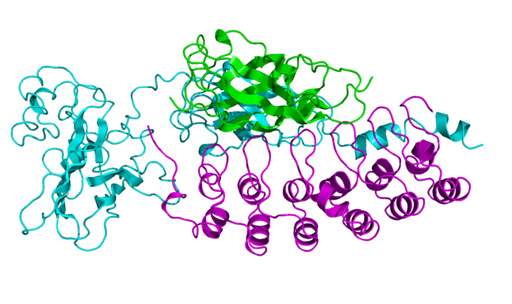
Image: The molecular model of the protein IkappaBalpha (NF-kappaB inhibitor, alpha) (Photo courtesy of Wikimedia Commons).
They investigators reported in the December 29, 2016, online edition of the journal Molecular Cell that an intrinsic constitutively activated feedforward signaling circuit was formed during the emergence of castration-resistant prostate cancer (CRPC). This signaling pathway comprised the microRNA miR-196b-3p and the proteins IkappaBalpha (NF-kappaB inhibitor, alpha)/NF-kappaB (nuclear factor of kappa light polypeptide gene enhancer in B-cells), Meis2 (Homeobox protein Meis2), and PPP3CC (protein phosphatase 3 catalytic subunit gamma).
NF-kappaB inhibitor, alpha is one member of a family of cellular proteins that function to inhibit the NF-kappaB transcription factor. IkappaBalpha inhibits NF-kappaB by masking the nuclear localization signals of NF-kappaB proteins and keeping them sequestered in an inactive state in the cytoplasm. In addition, IkappaBalpha blocks the ability of NF-kappaB transcription factors to bind to DNA, which is required for NF-kappaB's proper functioning. Inactivation of the IkappaBalpha protein causes NF-kappaB to be chronically active in tumor cells and this activity contributes to the malignant state of these tumor cells.
The use of NF-kappaB inhibitors in treating cancer is complicated by severe side effects related to immunosuppression caused by indiscriminate inhibition of NF-kappaB in normal immune cells. However, the investigators suggested that targeting the other non-IkappaBalpha/NF-kappaB components in this signaling circuit would avoid the suppression of NF-kappaB in normal immune cells while keeping the potent anti-cancer efficacy.
"Disrupting this circuit by targeting any of its individual components blocks the expression of these transcription factors and significantly impairs therapy-resistant prostate cancer," said first author Dr. Ji-Hak Jeong, a research associate at The Scripps Research Institute.
Related Links:
The Scripps Research Institute




Platinum Member

Automated Coagulation Analyzer
Hemolumi H6
Gold Member

Nucleic Acid Extractor System
NEOS-96 XT
New

Slide Scanner System
NanoZoomer S540MD

New

Automated Immunoassay Analyzer
SuperFlex™