Preventing Type II Diabetes Requires Putting the Brakes on Zinc Transport Protein
By LabMedica International staff writers
Posted on 29 Dec 2016
The enhanced activity of a zinc transport protein encoded by a fairly common gene variant has been linked to heightened risk of developing type II diabetes.Posted on 29 Dec 2016
Zinc is a critical element for insulin storage in the secretory granules of pancreatic beta cells. The islet-specific zinc transporter ZnT8 mediates granular sequestration of zinc ions. A genetic variant of human ZnT8 arising from a single nonsynonymous nucleotide change in the SLC30A8 (solute carrier family 30 member 8) gene contributes to increased susceptibility to type II diabetes, but it has remained unclear how the high-risk variant (R325), which is also a higher-frequency allele, is correlated with zinc transport activity.
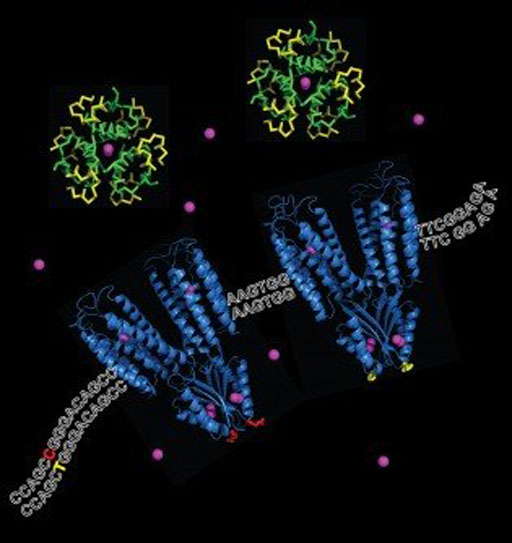
Image: An illustration of the high-risk (left) and low-risk (right) versions of the ZnT8 protein as it transports zinc ions (purple spheres) across a cell membrane, where it binds with insulin (green and yellow). The letters show the difference in the DNA code that produces the variation in proteins (Photo courtesy of Drs. Chengfeng Merriman and Dax Fu, Johns Hopkins University).
Previous genomics studies have shown that variants of SLC30A8 were closely related to risk of developing type II diabetes. Individuals with the more common R325 version of the gene had a 12% greater likelihood of developing the disease than did those with the less common W325 form. Individuals with a very rare, inactive form of the gene had very low risk of developing type II diabetes.
In the current study, investigators at Johns Hopkins University (Baltimore, MD, USA) compared the activity of R325 with that of the low-risk W325 ZnT8 variant. They reported in the November 8, 2016, online edition of the Journal of Biological Chemistry that the R325 variant was some 57% more active than the W325 form following induced expression in HEK293 cells.
Over a broad range of permissive lipid compositions, the R325 variant consistently exhibited accelerated zinc transport kinetics versus the W form. In agreement with the human genetic finding that rare loss-of-function (LOF) mutations in ZnT8 were associated with reduced type II diabetes risk, these results suggested that the common high-risk R325 variant was hyperactive.
"Given that type II diabetes is a growing global epidemic, it has long seemed that a drug targeting the protein SLC30A8 makes, namely ZnT8 or zinc transporter 8, would potentially have a huge impact," said senior author Dr. Dax Fu, associate professor of physiology at Johns Hopkins University. "The problem was that studies on ZnT8 had not clarified whether the protein needed to be souped up or slowed down to reduce risk. In this case, breaking the "speed limit" brings disease risk."
Related Links:
Johns Hopkins University




Platinum Member

Automated Coagulation Analyzer
Hemolumi H6
Gold Member

Blood-Based Protein Biomarker Solution for Alzheimer's Disease
BG-DTi2000.

Hematology Consumables
Bioblood Devices
New

Alzheimer's Disease Biomarker Assay
Elecsys Phospho-Tau (217P) Plasma