






Protein Helps Neurons Maintain Dopamine Production in Models of Parkinson's Disease
By LabMedica International staff writers
Posted on 20 Oct 2016
A team of neurodegenerative disease researchers has identified a protein that seems to help neurons in the brain maintain dopamine production.Posted on 20 Oct 2016
Investigators at Iowa State University (Ames, USA) have been studying Prokineticin-2 (PK2), a recently discovered secreted protein that regulates important physiological functions including olfactory biogenesis and circadian rhythms in the central nervous system.
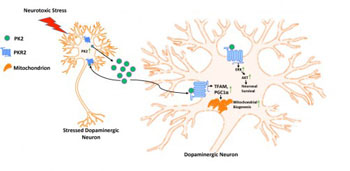
Image: Diagram shows how the neuropeptide Prokineticin-2 (PK2) is rapidly induced during early stages of neurotoxic stress and secreted into extracellular spaces. PK2 is thought to act as a protective mechanism that helps neurons cope with Parkinson’s disease (Photo courtesy of Dr. Anumantha Kanthasamy, Iowa State University).
They reported in the October 5, 2016, online edition of the journal Nature Communications that although in mouse models PK2 expression was low in the nigral system of the brain, its receptors were constitutively expressed on nigrostriatal neurons, and that PK2 expression was highly induced in nigral dopaminergic neurons during early stages of degeneration in multiple mouse models of Parkinson’s disease (PD).
Functional studies demonstrated that PK2 promoted mitochondrial biogenesis and activated ERK (Extracellular signal-regulated kinase) and Akt (Protein kinase B) survival signaling pathways, thereby driving neuroprotection. Importantly, PK2 overexpression was protective, whereas PK2 receptor antagonism exacerbated dopaminergic degeneration in experimental PD.
PK2 signaling protected against oxidative stress, mitochondrial dysfunction, and dopaminergic degeneration. Blocking PK2 signaling using a PK2 receptor antagonist increased dopaminergic degeneration in a PD mouse model, while overexpression of PK2 by adeno-associated virus (AAV) gene delivery was neuroprotective. PK2 expression was also found to be elevated in the substantia nigra (SN) of PD patients, corroborating PK2’s clinical relevance in human PD.
“Of the thousands and thousands of factors we tracked in our experiments, why was this protein expressed so highly?” said senior author Dr. Anumantha Kanthasamy, professor of veterinary medicine at Iowa State University. “The neurons use PK2 to cope with stress. It is an in-built protective mechanism.”
Related Links:
Iowa State University




Platinum Member

Automated Coagulation Analyzer
Hemolumi H6
Gold Member

Automatic Hematology Analyzer
CF9600

Automatic CLIA Analyzer
Shine i6000
Platinum Member
Integrated Biochemical & Immunological System
Biolumi CX Solution X10+C10


