Inhibiting Enzyme Activity Overcomes Cell Differentiation Blockade
By LabMedica International staff writers
Posted on 26 Sep 2016
Inhibition of the enzyme dihydroorotate dehydrogenase (DHODH) was found to stimulate differentiation of acute myeloid leukemia (AML) cells, which reduced the cancer cell burden and promoted survival in human and mouse models.Posted on 26 Sep 2016
AML is a cancer of the myeloid line of blood cells, characterized by the rapid growth of abnormal white blood cells that accumulate in the bone marrow and interfere with the production of normal blood cells. The symptoms of AML are caused by replacement of normal bone marrow with leukemic cells, which causes a drop in red blood cells, platelets, and normal white blood cells. Symptoms include fatigue, shortness of breath, easy bruising and bleeding, and increased risk of infection. AML progresses rapidly and is typically fatal within weeks or months if left untreated.
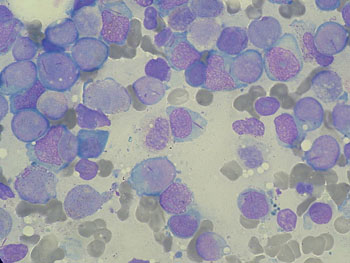
Image: A photomicrograph of bone marrow aspirate showing acute myeloid leukemia (AML) (Photo courtesy of Wikimedia Commons).
Investigators at the Harvard Medical School (Boston, MA, USA) screened more than 330,000 compounds while searching for new drugs to treat AML. They identified a dozen compounds that forced the leukemic cells to differentiate, and of those, 11 blocked the metabolic enzyme dihydroorotate dehydrogenase (DHODH). This enzyme, which is encoded by the DHODH gene on chromosome 16, catalyzes the fourth enzymatic step, the ubiquinone-mediated oxidation of dihydroorotate to orotate, in de novo pyrimidine biosynthesis. DHODH is a mitochondrial protein located on the outer surface of the inner mitochondrial membrane (IMM). Inhibitors of this enzyme are used to treat autoimmune diseases such as rheumatoid arthritis.
The investigators reported in the September 15, 2016, online edition of the journal Cell that in vivo treatment with DHODH inhibitors reduced leukemic cell burden, decreased levels of leukemia-initiating cells, and improved survival of mice with AML and mice injected with human leukemia cells. These results demonstrated the role of DHODH as a metabolic regulator of differentiation and pointed to its inhibition as a strategy for overcoming differentiation blockade in AML.
"We need desperately to find new therapies, not only for the 20,000 people diagnosed with AML every year, but for all cancers," said senior author Dr. David Scadden, professor of medicine at Harvard Medical School. "We think that an approach to overcome the differentiation blockade of cancer may be a strategy with broad application and one we should explore for other cancer types."
Related Links:
Harvard Medical School




Platinum Member

Automated Coagulation Analyzer
Hemolumi H6
Gold Member

Fully-auto Specific Protein (Nephelometry) Analyzer
PA240


Thyroid Test
Anti-Thyroid EIA Test
New

Neurofilament Light Chain Assay
Lumipulse G NfL Blood