New Insights Regarding the Genetic Factors that Drive Melanoma Development
By LabMedica International staff writers
Posted on 09 Jun 2016
Cancer researchers have linked both active and inactive forms of the protein ATF2 (Activating transcription factor 2) to the development and progression of malignant melanoma.Posted on 09 Jun 2016
Investigators at the Sanford Burnham Prebys Medical Discovery Institute (La Jolla, CA, USA) have been studying the role of ATF2 in melanoma development for more than 20 years. They have shown, for example, that in melanoma, nuclear ATF2 expression was associated with poor prognosis and metastatic burden, whereas cytoplasmic localization correlated with sensitization of melanoma to genotoxic stress and susceptibility to chemotherapy.
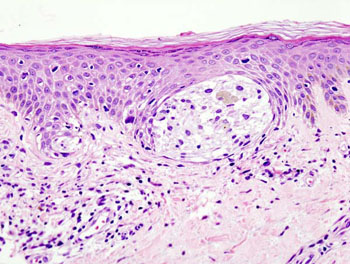
Image: A skin biopsy with melanoma present (Photo courtesy of Wikimedia Commons).
In their latest paper on the topic published in the May 19, 2016, online edition of the journal Cell Reports, the investigators reported finding an inactive version of AFT2 that elicited a tumor-promoting effect in a way that they had not seen previously. They had been evaluating the oncogenic potential of an inactivated form of ATF2 in mice with mutations in BRAF, a kinase that transmits signals promoting cell division that is often mutated in pigmented skin cells.
“Inactive ATF2, in mice with mutant BRAF, resulted in the formation of pigmented lesions and later, melanoma tumors,” said senior author Dr. Ze’ev Ronai, professor in the cancer center at the Sanford Burnham Prebys Medical Discovery Institute.
“What makes this discovery relevant to human melanoma is that we identified a structurally similar form of inactive ATF2 in human melanoma samples that has the same effects on cancer cells. Inactive ATF2 could be an indicator of tumor aggressiveness in patients with BRAF mutations, and maybe other types of cancer as well.”
“Unlike models with more complex genetic changes, like the inactivation of PTEN and p16 combined with BRAF mutations that result in rapid tumorigenesis (within a few weeks), the inactive ATF2 caused BRAF mutant mice to develop melanoma much slower, more similar to the timescale seen in patients,” said Dr. Ronai. “This improves our ability to monitor the development of melanoma and efficacy of possible interventions. We are now investigating why inactive ATF2 so potently promotes BRAF-mutant melanoma, and looking for other types of cancer where it acts the same way. Our findings may guide precision therapies for tumors with mutant ATF2.”
Related Links:
Sanford Burnham Prebys Medical Discovery Institute




Platinum Member

Automated Coagulation Analyzer
Hemolumi H6

Gold Member

Platelet Function Analyzer
PL-12


All-in-One Molecular System
AIO M160
New

Microbiology Laboratory Automation Solution
BD Kiestra™ ReadA+BarcodA