Novel Microcapsule Approach Reduces Toxic Side Effects of Chemotherapy
By LabMedica International staff writers
Posted on 26 May 2015
Cancer researchers have reduced chemotherapy's toxic side effects by using nanoporous capsules to transport an enzyme to the site of a tumor where it is activated by a selective heating process to convert a pro-drug into a toxic anticancer agent.Posted on 26 May 2015
Investigators at Dartmouth College (Hanover, NH, USA) genetically engineered Escherichia coli bacteria to express high levels of the enzyme cytosine deaminase, which converts cytosine and water into uracil and ammonia, at elevated temperatures, under the transcriptional control of a thermo-regulatory lambd-apL-cI857 promoter cassette.
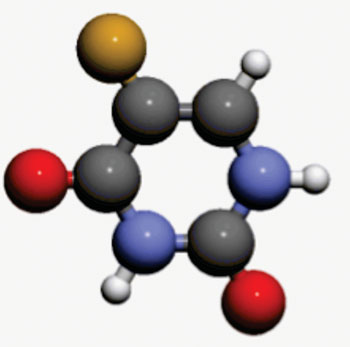
Image: Molecular model of the anti-cancer drug 5-fluorouracil (Photo courtesy of Wikimedia Commons).
The investigators encapsulated the modified E.coli together with magnetic iron oxide nanoparticles in immunoprotective alginate microcapsules. Following take up of the microcapsules by tumor cells, cytosine deaminase expression in the E. coli was triggered remotely by alternating magnetic field (AMF)-induced hyperthermia. When AMF warmed the magnetic iron oxide nanoparticles to 42 degrees Celsius, the high temperature activated the cytosine deaminase produced by the bacteria, which then catalyzed the conversion of nontoxic 5-fluorocytosine to 5-fluorouracil (5FU). 5-FU is a thymidylate synthase (TS) inhibitor that interrupts the action of this enzyme and by doing so blocks synthesis of the pyrimidine thymidine, which is a nucleoside required for DNA replication.
Results published in the March 25, 2015, online edition of the Journal of Biotechnology revealed that the combination of 5-fluorocytosine with AMF-activated microcapsules demonstrated tumor cell cytotoxicity comparable to direct treatment with 5-fluorouracil chemotherapy but without the toxic systemic side effects.
"We have engineered cells that locally convert a nontoxic substance into an antitumor agent," said senior author Dr. Barjor Gimi, associate professor of radiology and of medicine at Dartmouth College. "We can encapsulate cells in nanoporous capsules, which ensures the cells are localized and immunoisolated. This immunoisolated micro-factory can remain in the tumor, providing a permanent and renewable source of therapeutic molecules for long-term cancer management."
Related Links:
Dartmouth College




Platinum Member

Automated Coagulation Analyzer
Hemolumi H6
Gold Member

NEW PRODUCT : SILICONE WASHING MACHINE TRAY COVER WITH VICOLAB SILICONE NET VICOLAB®
REGISTRED 682.9
Gold Member

Blood-Based Protein Biomarker Solution for Alzheimer's Disease
BG-DTi2000.

All-in-One Molecular System
AIO M160