Neurons Derived from the Skin Cells of Epilepsy Patients Embody New Platform for Drug Testing
By LabMedica International staff writers
Posted on 08 Aug 2013
Stem cells derived from skin taken from juvenile epilepsy patients were induced to mature into cultures of neurons that were developed into a human-based system for the study of the genetic factors that underlie the disorder and for development of drugs to control the disease.Posted on 08 Aug 2013
Investigators at the University of Michigan Medical School (Ann Arbor, USA) derived forebrain-like pyramidal- and bipolar-shaped neurons from two Dravet syndrome (DS) subjects and three human controls by iPSC (induced pluripotent stem cell) reprogramming of fibroblasts. DS is a severe form of childhood epilepsy typically caused by dominant mutations in the SCN1A (sodium channel, voltage-gated, type I, alpha subunit) gene encoding the voltage-gated sodium channel Nav1.1.
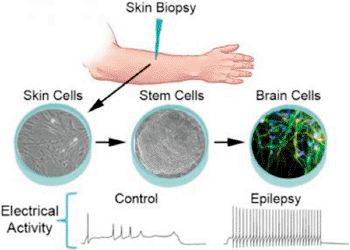
Image: This diagram shows the process by which scientists can take skin cells from patients with epilepsy, convert them to stem cells, and then create neurons (brain nerve cells) from them. The induced neurons contain the same genetic mutation(s) carried by the patients (Photo courtesy of the University of Michigan Medical School).
DS and control iPSC-derived neurons were compared using whole-cell patch clamp recordings. Sodium current density and intrinsic neuronal excitability were also examined. Results published in the July 2, 2013, online edition of the journal the Annals of Neurology revealed that neural progenitors from DS and human control iPSCs displayed a forebrain identity and differentiated into bipolar- and pyramidal-shaped neurons.
DS patient-derived neurons showed increased sodium currents in both bipolar- and pyramidal-shaped neurons. Consistent with increased sodium currents, both types of DS patient-derived neurons showed spontaneous bursting and other evidence of hyperexcitability that could potentially set off seizures. Neurons derived from the skin cells of individuals without epilepsy displayed none of this abnormal activity.
"With this technique, we can study cells that closely resemble the patient's own brain cells, without doing a brain biopsy," said senior author Dr. Jack M. Parent, professor of neurology at the University of Michigan Medical School. "It appears that the cells are overcompensating for the loss of channels due to the mutation. These patient-specific induced neurons hold great promise for modeling seizure disorders, and potentially screening medications."
The findings obtained during this study revealed a previously unrecognized cell-autonomous epilepsy mechanism underlying DS, and offer a platform for screening new antiepileptic therapies.
Related Links:
University of Michigan




Platinum Member

Automated Coagulation Analyzer
Hemolumi H6

New
Gold Member

Serum Indices Control
Acusera Serum Indices Control
New

Alzheimer's Disease Biomarker Assay
Elecsys Phospho-Tau (217P) Plasma

CMV CLIA Diagnostic
CLIA CMV IgA Screen Group