Nobel Prize Awarded for Fundamental Discoveries in the Developmental Capacity of Mature Cells
By LabMedica International staff writers
Posted on 15 Oct 2012
The 2012 Nobel Prize for Physiology or Medicine jointly awarded to scientists John B. Gurdon and Shinya Yamanaka recognizes the fundamental nature of their discoveries about the capacity of mature, specialized cells to be reprogrammed back into immature, pluripotent stem-like cells. The prize also reflects recognition of important progress being made in medical research based on these groundbreaking discoveries.Posted on 15 Oct 2012
The process of developing from an immature into a specialized cell was previously considered to be unidirectional and irreversible. It was thought that during maturation the cell undergoes certain changes that include loss of the capacity to return to a pluripotent stage. John B. Gurdon, long-time professor of cell biology at the University of Cambridge (Cambridge, UK) and currently at the Gurdon Institute (Cambridge, UK), challenged this dogma that the specialized cell is irreversibly committed. In 1962, Prof. Gurdon published a landmark study in the Journal of Embryology and Experimental Morphology titled “The developmental capacity of nuclei taken from intestinal epithelium cells of feeding tadpoles.” In this classic experiment, he replaced the immature nucleus of a frog egg cell with the nucleus from a mature intestinal cell. This modified egg cell developed into a normal tadpole, showing that the DNA of the mature cell still contained all the genetic information required for the development of all the cells of a fully functional frog. This conclusion was eventually confirmed and generalized to other organisms, including mammals, by independent studies performed by other researchers.
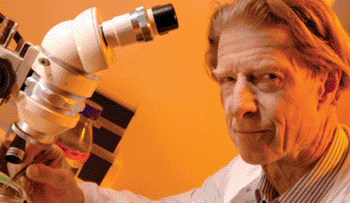
Image: 2012 Nobel laureate Prof. John B. Gurdon in his laboratory (Photo courtesy of the Nobel Foundation).
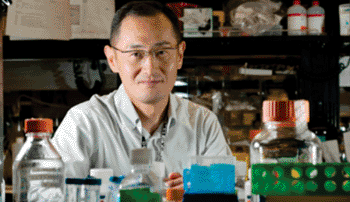
Image: 2012 Nobel laureate Prof. Shinya Yamanaka in his laboratory (Photo courtesy of the Nobel Foundation).
Prof. Gurdon’s experiment involved mechanical removal of intact nuclei from cells and introduction of a nucleus from a specialized cell into a de-nucleated nonspecialized cell. Over 40 years later, Shinya Yamanaka, currently professor at Kyoto University (Kyoto, Japan) and affiliated with the Gladstone Institutes (San Francisco, CA, USA), discovered that it was also possible to reprogram fully intact mature cells to become pluripotent cells by the introduction of only a few specific genes in a specific combination, discovered by testing various combinations from a set of previously identified candidate genes. This groundbreaking study from Prof. Yamanaka’s laboratory was published in 2006 in the journal Cell, titled “Induction of pluripotent stem cells from mouse embryonic and adult fibroblast cultures by defined factors.” These induced pluripotent stem cells (iPSC) have already constituted another breakthrough in developmental biology. And by reprogramming also human cells, scientists have created new opportunities to study human disease mechanisms and develop methods for medical therapy and diagnosis.
Related Links:
Nobel Foundation
Gurdon Institute
Kyoto University




Platinum Member

Automated Coagulation Analyzer
Hemolumi H6

Gold Member

Blood-Based Protein Biomarker Solution for Alzheimer's Disease
BG-DTi2000.
Platinum Member
Integrated Biochemical & Immunological System
Biolumi CX Solution X10+C10


Urine Analyzer
respons® UDS100