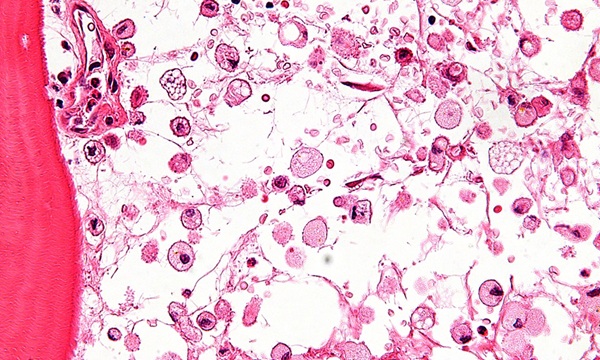
3D Tumor Model Developed to Speed Cancer Drug Research
By LabMedica International staff writers
Posted on 22 Jun 2011
A team of scientists has developed a way to induce tumor cells in the laboratory to grow into three-dimensional (3D) spheres. Their work takes advantage of an earlier technique of generating spherical cavities in a common polymer and has the potential to create more accurate tests of new cancer therapies. Posted on 22 Jun 2011
As team leader Michael R. King, PhD, of Cornell University (Ithaca, NY, USA), explained, "Sometimes engineering research tends to be a case of a hammer looking for a nail. We knew our previous discovery was new and it was cool. And now we know it's useful."
Three years ago, the investigators--in collaboration with Lisa DeLouise, PhD, MPD, (Rochester, NY, USA)--perfected a low-cost, easy fabrication technique to construct spherical cavities in PDMS (polydimethylsiloxane), a widely used silicon organic polymer. More recently, the Cornell team discovered that these cavities could be utilized as a scaffolding to grow many tumor spheroids, which could serve as realistic models for cancer cells. The study was published online June 3, 2011, in Biomicrofluidics, a publication of the American Institute of Physics.
The three-dimensional spheroids hold the potential to speed cancer drug discovery by providing an effective and easily accessible substrate on which to test drugs. Their 3D character is an asset because in the body, tumor cells grow in 3D--yet most laboratory studies of cancer have been conducted in 2D, with a single layer of cancer cells grown on the bottom of a Petri dish. Too frequently, a potential 2D drug candidate fails when it enters the 3D stage of animal testing. The new 3D tumor spheroids may help eliminate that drawback. They also offer a realistic tumor oxygen environment that cues the blood vessel growth that nourishes tumors--an attractive target for anticancer drug design.
"Basically, any laboratory that works with cells could adopt our new spherical microcavity system to do their own 3D experiments or drug screening on hundreds or even thousands of little tumor spheroids," concluded Dr. King.
Related Links:
Cornell University




Platinum Member

Automated Coagulation Analyzer
Hemolumi H6

Gold Member

Platelet Function Analyzer
PL-12
New

Portable POCT Blood Gas Analyzer
BD100

POC Immunoassay Analyzer
Procise DX