Controlling Calcium Homeostasis Could Stabilize Alzheimer's Disease
By Biotechdaily staff writers
Posted on 28 Jul 2008
Posted on 28 Jul 2008
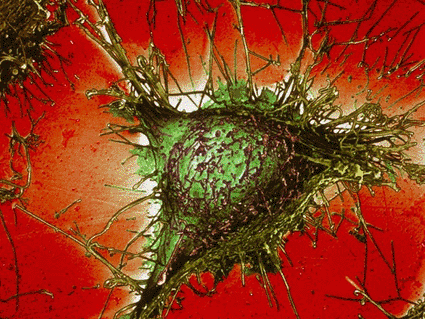
Image: Colored scanning electron micrograph (SEM) of a cell used in Alzheimer’s disease research that has genetically engineered to produce amyloid protein (Photo courtesy of Simon Fraser).
Researchers at the department of neurobiology and behavior at the University of California Irvine (USA), reported that the sarco ER Ca2+-ATPase (SERCA) system, which pumps excess Ca2+ into the endoplasmic reticulum (ER) or its muscle equivalent, the sarcoplasmic reticulum (SR), has diminished activity in cells lacking presenilin-1 and presenilin-2 (PS1, PS2). The deficiencies are associated at the cellular level with increased production of the proteotoxic peptide Aß1-42, and at the organismal level with increased risk of early-onset AD. Modulation of SERCA activity on its own can affect the rate of Aß synthesis. Taken together, the data argue that PS1 and PS2 regulate intracellular Ca2+, and that calcium in turn influences production of Aß (and thereby the risk and progression of AD).
Another study, by researchers at the Feinstein Institute for Medical Research (Manhasset, NY, USA) identified CALHM1, a calcium pump on the plasma membrane (as opposed to the ER/SR membrane) that is also involved in Aß production. A naturally occurring polymorphism in the CALHM1 gene is strongly associated with AD; the authors propose that the mutation interferes with Ca2+ permeability and that this alters Aß expression via an as-yet-undetermined mechanism.
When combining the two studies, calcium is seen to be moving in opposite directions; SERCA pumps Ca2+ out of the cytosol into the ER/SR, so a deficiency in SERCA would increase cytosolic Ca2+. In contrast, CALHM1 pumps Ca2+ into the cytosol, so that a deficiency in that protein would decrease cytosolic Ca2+. However, deficiencies in either gene promote AD. The studies suggest that the similar effects on Aß levels are mediated by two very different mechanisms.
Amyloid ß is a peptide that is the main constituent of amyloid plaques in the brains of Alzheimer's disease patients. Amyloid ß also forms aggregates coating cerebral blood vessels in cerebral amyloid angiopathy. These plaques are composed of a tangle of regularly ordered fibrillar aggregates called amyloid fibers, a protein fold shared by other peptides such as prions associated with protein misfolding diseases. Research on laboratory rats suggests that the two-molecule, soluble form of the peptide is a causative agent in the development of AD.
Related Links:
University of California Irvine
Feinstein Institute for Medical Research




Platinum Member

Automated Coagulation Analyzer
Hemolumi H6
Gold Member

Nucleic Acid Extractor System
NEOS-96 XT


POC Immunoassay Analyzer
Procise DX
New
Gold Member

Serum Indices Control
Acusera Serum Indices Control