LNA-mediated microRNA Silencing Used to Lower Cholesterol in Monkeys
By Biotechdaily staff writers
Posted on 08 Apr 2008
Posted on 08 Apr 2008
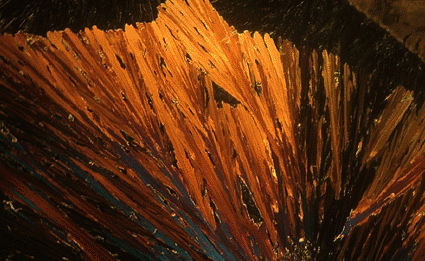
Image: Polarized light micrograph of crystals of cholesterol (Photo courtesy of BSIP Gorie / SPL).
MiRNAs are single-stranded RNA molecules of about 21-23 nucleotides in length, which regulate gene expression. MiRNAs are encoded by genes that are transcribed from DNA but not translated into protein; instead they are processed from primary transcripts known as pri-miRNA to short stem-loop structures called pre-miRNA and finally to functional miRNA. Mature miRNA molecules are partially complementary to one or more messenger RNA (mRNA) molecules, and their main function is to down-regulate gene expression. Investigators at Santaris Pharma (Hørsholm, Denmark) worked with a special type of miRNA called a locked-nucleic-acid-modified oligonucleotide (LNA-antimiR).
The investigators injected African green monkeys with three intravenous doses of LNA-antimiR-122. They reported in the March 26, 2008, online edition of the journal Nature that the compound was taken up by liver cells, and that it formed stable hetero duplexes with miR-122. This was accompanied by depletion of mature miR-122 and dose-dependent lowering of plasma cholesterol. This long-lasting and reversible decrease in total plasma cholesterol occurred without any evidence for LNA-associated toxicities or histopathological changes in the study animals.
"We are excited by the results from this study, which demonstrate the great promise that LNA technology holds for targeting microRNAs and exploring their function in vivo,” said senior author Dr. Sakari Kauppinen, director of microRNA research at Santaris Pharma. "In the study, we used a simple intravenous delivery of an unconjugated LNA-antimiR to antagonize the liver-expressed microRNA-122 in African green monkeys, which resulted in long-lasting, efficient and reversible decrease in total plasma cholesterol without any evidence of adverse reactions. Even though further studies will be needed to optimize the dosing regimen and to assess the safety of LNA-antimiR compounds after long-term treatment, our findings represent an important step towards the development of LNA-based microRNA therapeutics.”
Related Links:
Santaris Pharma




Platinum Member

Automated Coagulation Analyzer
Hemolumi H6
Gold Member

NEW PRODUCT : SILICONE WASHING MACHINE TRAY COVER WITH VICOLAB SILICONE NET VICOLAB®
REGISTRED 682.9
New

Slide Scanner System
NanoZoomer S540MD
Urine Analyzer
respons® UDS100