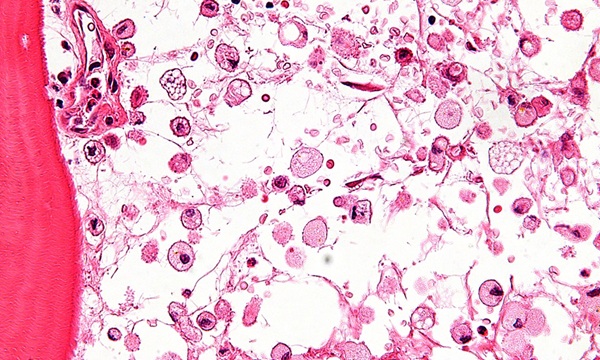
Cancer-fighting Virus Shows Promise in Early Clinical Trial
By Biotechdaily staff writers
Posted on 18 Jul 2007
Posted on 18 Jul 2007
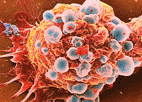
Image
The virus, called NV1020, is a type of herpes simplex virus engineered so that it selectively replicates in virus cells, destroying them in the process. The researchers presented their data in July 2007 at the European Society for Medical Oncology (ESMO) Conference held in Lugano, Switzerland.
"It doesn't replicate in normal, healthy cells, so our hope is that it will help fight cancers without causing side-effects in the rest of the body,” said Dr. Axel Mescheder, vice president of Clinical Research & Development, from the biotech company MediGene (Munich, Germany).
The study is being conducted in seven leading US-cancer centers, with Dr. Tony Reid from the University of California in San Diego (UCSD; CA, USA) as principal investigator. Dr. Mescheder presented preliminary safety and efficacy results and a case report from this ongoing clinical trial in patients with colorectal cancer metastatic to the liver at the meeting. Dr. Mescheder's poster presentation described the case of a patient whose cancer had metastasized to 10 different places around the liver and four in the lungs. He was given the virus treatment in four weekly infusions direct into blood stream, followed by two cycles of approved chemotherapy.
Six months after treatment, scans showed the liver masses had nearly disappeared. "The reduction in the tumor masses was really impressive in this patient,” Dr. Mescheder said. "The hepatic masses almost disappeared.”
The patient survived for 12 months after treatment. "In the current study, the scientists are testing the treatment in patients with colorectal cancer that have not responded to chemotherapy and where the cancer has spread to the liver,” Dr. Mescheder said. "We are hoping to extend overall survival.” Up to now, the findings are looking positive. The treatment seems very tolerable for patients and safe. "The results are really quite encouraging at this early stage.”
Nearly 40% of patients with colorectal cancer eventually die from metastatic disease, where the cancer spreads to other parts of the body. Most of the metastasis occurs to the liver and 15% of patients have liver metastases at the time of diagnosis.
These latest human findings follow testing in the laboratory and in animals where the virus was shown to be effective at killing colorectal cancer cells and liver cancers.
Related Links:
MediGene
University of California in San Diego




Platinum Member

Automated Coagulation Analyzer
Hemolumi H6
Gold Member

NEW PRODUCT : SILICONE WASHING MACHINE TRAY COVER WITH VICOLAB SILICONE NET VICOLAB®
REGISTRED 682.9
New

Slide Scanner System
NanoZoomer S540MD

New

Automated Immunoassay Analyzer
SuperFlex™