A New Index Measures Liver Fibrosis
By Biotechdaily staff writers
Posted on 14 Feb 2007
Posted on 14 Feb 2007
Image
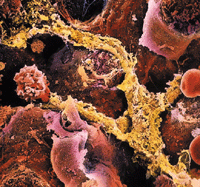
Fibrosis, the formation of scar-like tissue in the liver, usually indicates damage and can lead to cirrhosis. The new series of markers, called FibroIndex, was found to more accurately diagnose fibrosis than two other indices that are commonly used.
In patients with hepatitis C, determining the stage of liver fibrosis is important for prognosis and treatment. Liver biopsy is the gold standard, but it is invasive and costly. The current study tested an index of routinely available blood tests to predict significant fibrosis in hepatitis C patients and compared it to two other indices, the Forns' index and aspartate aminotransferase to platelet ration index (APRI).
Led by Masahiko Koda of Tottori University (Tottori, Japan), the study included 402 patients with chronic hepatitis C who were scheduled to undergo a liver biopsy between April 1994 and March 2004. Blood samples were collected within three days of the biopsy and patients who had previously been diagnosed with cirrhosis were not included. The researchers identified platelets, asparto amino transferase (AST, a liver enzyme), and gamma-globulin (a protein in the blood that helps fight infection) as independent predictors of fibrosis and used these to construct the FibroIndex equation.
The results showed that FibroIndex was more accurate in predicting significant or severe fibrosis than Forns' index or APRI. By determining cutoff values to identify the absence or presence of significant fibrosis, the study found that 101 patients could have avoided a liver biopsy. In addition, the FibroIndex was applied to a subgroup of 30 patients treated with interferon who underwent a second biopsy more than one year after treatment. Changes in FibroIndex were found to correlate with changes in fibrosis, while APRI and Forns' index did not show this correlation. FibroIndex was also accurate in patients with normal levels of the liver enzyme alkaline phosphatase (ALT), one third of whom had significant fibrosis.
The authors pointed out that blood tests for the predictors used by FibroIndex are routinely available in most hospitals and laboratories, making it a widely accessible tool for determining fibrosis. Although other markers can be useful in diagnosing fibrosis, their measurements are less standardized and expensive. The sensitivity of FibroIndex was limited, which may be due to variation found in laboratory tests. Nevertheless, they concluded: The utilization of FibroIndex should decrease the number of liver biopsies necessary during follow-up of patients with hepatitis C and could safely provide longitudinal data on the progression of liver fibrosis. It could also provide important information on the clinical course of hepatitis C and help evaluate the effect of treatment.
The results of the study appear in the February 2007 issue of Hepatology, the official journal of the American Association for the Study of Liver Diseases (AASLD).
Related Links:
Tottori University




Platinum Member

Automated Coagulation Analyzer
Hemolumi H6
Gold Member

NEW PRODUCT : SILICONE WASHING MACHINE TRAY COVER WITH VICOLAB SILICONE NET VICOLAB®
REGISTRED 682.9
New

MR-proADM Test
B•R•A•H•M•S MR-proADM KRYPTOR test

HPV Test
Allplex HPV28 Detection