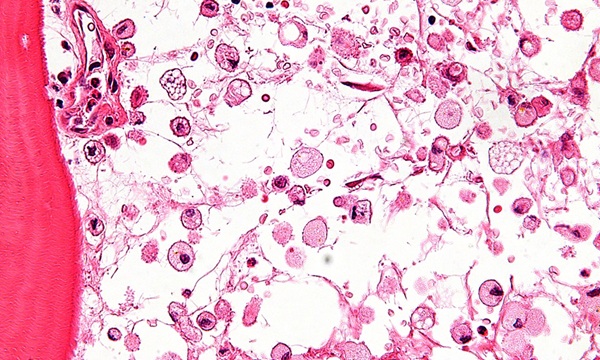
Arachidonic Acid Stimulates Cancer Growth
By Biotechdaily staff writers
Posted on 16 Feb 2006
Researchers have found that arachidonic acid, an omega-6 fatty acid, stimulated the growth of tumor cells by activating the metabolic pathway leading to prostaglandin synthesis and translocation to the nucleus of nuclear factor-kappaB (NF-kappaB).Posted on 16 Feb 2006
Investigators at the San Francisco Veterans Administration Medical Center (CA, USA) added arachidonic acid to human prostate tumor cells growing in tissue culture. They found that this prompted the cells to grow at a rate nearly double that of control cells that did not receive arachidonic acid.
Analysis using gene chip technology showed that arachidonic acid induced 11 genes that were regulated by NF-kappaB. Within five minutes of addition of arachidonic acid prostaglandin E2 (PGE2) synthesis was increased, and analysis of upstream signal transduction showed that phosphatidylinositol 3-kinase (PI3K) was significantly activated. These events were followed by activation of Akt at 30 minutes, when a significant three-fold increase in translocation of NF-kappaB to the nucleus was seen. Interruption of the pathway by treatment with either a COX-2 inhibitor or with a PI3K inhibitor reversed the stimulatory effect of arachidonic acid. These findings were published in the February 1, 2006, issue of Cancer Research.
Senior author Dr. Mille Hughes-Fulford, director of the Laboratory of Cell Growth at the San Francisco Veterans Administration Medical Center, said, "Investigating the reasons for this rapid growth, we discovered that the omega-6 was turning on a dozen inflammatory genes that are known to be important in cancer. We then asked what was turning on those genes, and found that omega-6 fatty acids actually turn on a signal pathway called PI3-kinase that is known to be a key player in cancer. I am not a physician, and do not tell people how to eat, but in my own home I use only canola oil and olive oil. We do not eat deep-fried foods.”
Related Links:
San Francisco Veterans Administration Medical Center




Platinum Member

Automated Coagulation Analyzer
Hemolumi H6
Gold Member

NEW PRODUCT : SILICONE WASHING MACHINE TRAY COVER WITH VICOLAB SILICONE NET VICOLAB®
REGISTRED 682.9
New

Neurofilament Light Chain Assay
Lumipulse G NfL Blood
Gold Member

Platelet Function Analyzer
PL-12