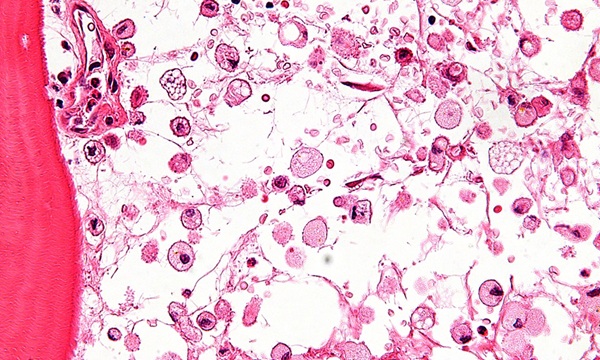
Compound Treats Breast Cancer
By Biotechdaily staff writers
Posted on 28 Jun 2005
Researchers have developed potentially effective drugs against breast cancer by combining molecules of the commonly used anesthetic propofol with molecules of omega-3 fatty acids.Posted on 28 Jun 2005
Investigators at Indiana University-Purdue University (Indianapolis, USA) based their study on earlier findings that both propofol and the omega-3 fatty acids DHA (docosahexaenoic acid) and EPA (eicosapentaenoic acid) slowed or prevented cancer growth. In the current work they synthesized two conjugates, propofol-docosahexaenoate (propofol-DHA) and propofol-eicosapentaenoate (propofol-EPA). The compounds were then tested against breast cancer cells growing in tissue cultures.
Results published in the June 7, 2005, issue of Breast Cancer Research revealed that propofol and DHA or EPA affected the cancer cells more significantly when used as molecular conjugates than when used alone. The conjugates inhibited cancer cell adhesion by 15% and 30% respectively, reduced cell migration by 50%, and increased apoptosis by 40%.
"These results suggest that the novel propofol-DHA and propofol-EPA conjugates reported here may be useful for the treatment of breast cancer,” said senior author Dr. Rafat Siddiqui, professor of biology at Indiana University-Purdue University. "It is possible that these conjugates provide a mechanism whereby propofol can be retained in cell membranes for a longer duration and therefore enhance its anticancer effects.”
Related Links:
Indiana University-Purdue University




Platinum Member

Automated Coagulation Analyzer
Hemolumi H6
Gold Member

Automatic Hematology Analyzer
CF9600


Portable POCT Blood Gas Analyzer
BD100
Platinum Member
Integrated Biochemical & Immunological System
Biolumi CX Solution X10+C10