Beckman Coulter Launches Fully Automated Platform to Streamline High-Throughput Urinalysis
Posted on 28 Jul 2026
Urinalysis is among the most frequently ordered diagnostics in emergency, inpatient, and primary care, yet many laboratories still rely on fragmented, manual workflows. Rising test volumes linked to diabetes, chronic kidney disease, and urinary tract infections are increasing demands for throughput and standardization. Core and reference laboratories also face variability and staffing strain from manual microscopic review. A new fully automated urinalysis system has now been introduced to address these workflow pressures.
Beckman Coulter Diagnostics has launched the DxU 1800 System in the United States, unveiling it at the Association for Diagnostics & Laboratory Medicine (ADLM) Annual Scientific Meeting & Clinical Lab Expo. The platform combines a new urine chemistry analyzer and dedicated consumables with the company’s proven microscopy technology. It is intended to help laboratories deliver standardized results at scale to support confident clinical decision-making.
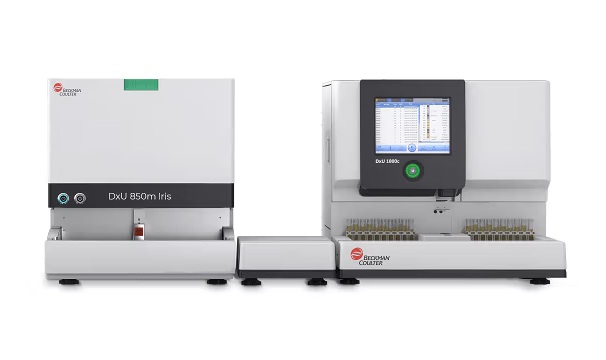
The system integrates the DxU 1800c Chemistry analyzer with a DxU Iris Microscopy analyzer, unifying chemical analysis and particle imaging on a single high-throughput platform. By automating and connecting these processes, the workflow reduces manual handoffs and supports greater consistency between chemistry and microscopy. Automated urine microscopy is described as reducing manual microscopic review rates to less than 3%, which is designed to improve throughput and reduce variability.
As a standalone unit, the DxU 1800c Chemistry analyzer processes up to 300 samples per hour. It supports storage of up to 2,000,000 samples and 100,000 strip images, and it displays strip image results on screen for review. In integrated use, the system is positioned to help laboratories scale operations with greater control by aligning chemistry and microscopy outputs.
Urine testing is widely utilized across care settings, with approximately one in three U.S. emergency department visits including a urine test and nearly half of admissions involving urinalysis. In non-acute care, up to 87% of primary care patients receive urine testing, and the test consistently ranks among the ten most-ordered assays. These patterns, together with rising burdens of diabetes, chronic kidney disease, and urinary tract infections, are increasing demand for standardized, high-throughput urinalysis.
Beckman Coulter Diagnostics indicates that an expanded chemistry menu is planned to include creatinine and microalbumin assays, which may provide additional kidney function insight as part of routine screening testing without requiring changes to existing laboratory workflow. The DxU 1800 System will be showcased at the ADLM 2026 Clinical Lab Expo in the Danaher booth (#3237). The platform is part of a connected ecosystem intended to streamline end-to-end urinalysis.
“Despite urinalysis’s essential role and growing volume trends, many laboratories still rely on workflows requiring manual review, fragmented processes or separate chemistry and microscopy systems. As testing shifts to larger core and reference labs, these inefficiencies can create bottlenecks, variability and staffing strain. The DxU 1800 System helps standardize testing, increase throughput and reduce manual microscopy, empowering laboratories to deliver consistent results that enable confident clinical decisions at scale,” said Matthew Rhyner, Vice President and Managing Director, Hematology and Urinalysis Business for Beckman Coulter Diagnostics.