Aptamer-Based Biosensor Enables Mutation-Resilient SARS-CoV-2 Detection
Posted on 04 Jun 2026
Rapid evolution of severe acute respiratory syndrome coronavirus 2 (SARS-CoV-2) can undermine existing molecular diagnostics, especially when assays target small viral components. Double-antibody sandwich immunoassays also face steric hindrance and limited sensitivity for nucleocapsid protein detection, highlighting the need for more resilient antigen recognition and stronger signal amplification. New findings demonstrate a DNA aptamer and dual-mode biosensing platform designed to address these challenges.
Hunan University (Changsha, China) and collaborators investigated NP14, a DNA aptamer that binds the N-terminal domain of the SARS-CoV-2 nucleocapsid protein, and paired it with a multicolor dynamic light scattering-enhanced enzyme-linked aptamer-antibody assay (MD ELAAA). The novel platform provides both rapid visual screening and quantitative readouts, and targets robust, mutation-resilient viral antigen detection.
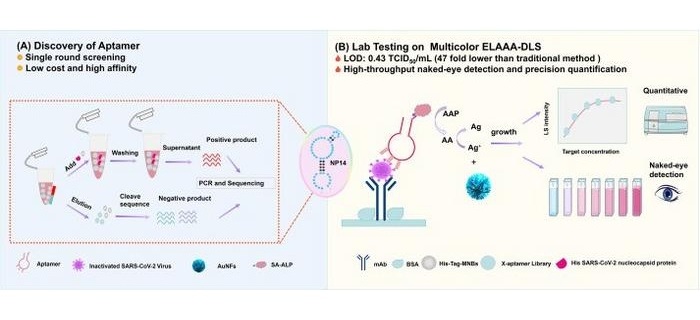
NP14 was identified using an approach called computer‑assisted X‑aptamer Systematic Evolution of Ligands by EXponential enrichment (SELEX). Molecular docking, targeted mutagenesis, and structural analyses indicated that nucleotides C24 and G27 within the P1 region are key determinants of target recognition. In the MD ELAAA, non‑aggregative plasmonic colorimetry enables naked‑eye assessment, while dynamic light scattering (DLS) supports ultrasensitive quantification.
Signal amplification in the assay is achieved when alkaline phosphatase catalyzes localized silver deposition onto gold nanoflowers (AuNFs), strengthening both colorimetric and light‑scattering outputs. Analytical testing showed broad‑spectrum recognition across diverse SARS‑CoV‑2 variants. The platform reached a limit of detection of 0.43 TCID50/mL and delivered a 47‑fold sensitivity improvement over traditional antibody‑based detection, enabling quantification of low‑abundance antigens in virus cultures.
The study was published in Genes & Diseases. The research team includes contributors from Hunan University, Texas A&M University Colleges of Medicine and Pharmacy, Baylor College of Medicine, and The University of Texas. The original paper is titled “Dual‑mode aptamer‑driven biosensing platform for ultrasensitive and mutation‑resilient detection of the SARS‑CoV‑2 nucleocapsid protein.”
According to the authors, additional real‑world clinical diagnostic studies are needed before routine implementation in point‑of‑care settings. The work concludes that deploying the NP14 aptamer within the MD ELAAA framework provides a dual‑action strategy to address viral mutation escape and low antigen concentration. The findings suggest dual‑mode aptamer‑driven biosensors could be strong candidates for next‑generation infectious disease diagnostics and high‑throughput surveillance.
Related Links
Hunan University