AI Tool Improves Prediction of Immunotherapy Response in Lung Cancer
Posted on 03 Sep 2026
Immune checkpoint therapies benefit only a subset of patients, while standard biomarkers often struggle to predict who will respond. Spatially resolved tumor profiling can provide deeper biological context, but it generates complex datasets that are difficult to compare across cases. A common, quantitative language for tumor architecture could strengthen therapeutic decision-making. New findings show that comparing tumor “floor plans” derived from spatial transcriptomics may predict immunotherapy response better than a current biomarker.
At the University of Chicago, investigators developed AI-based analytical tools that translate spatial transcriptomic profiles into quantifiable “floor plans” of the tumor microenvironment. The approach aggregates cells and gene activity into hierarchical “spatial groups,” providing standardized dimensions for how a biopsy is organized. By focusing on these spatial groups rather than individual cell populations or genes, the method enables objective comparisons between tumors.
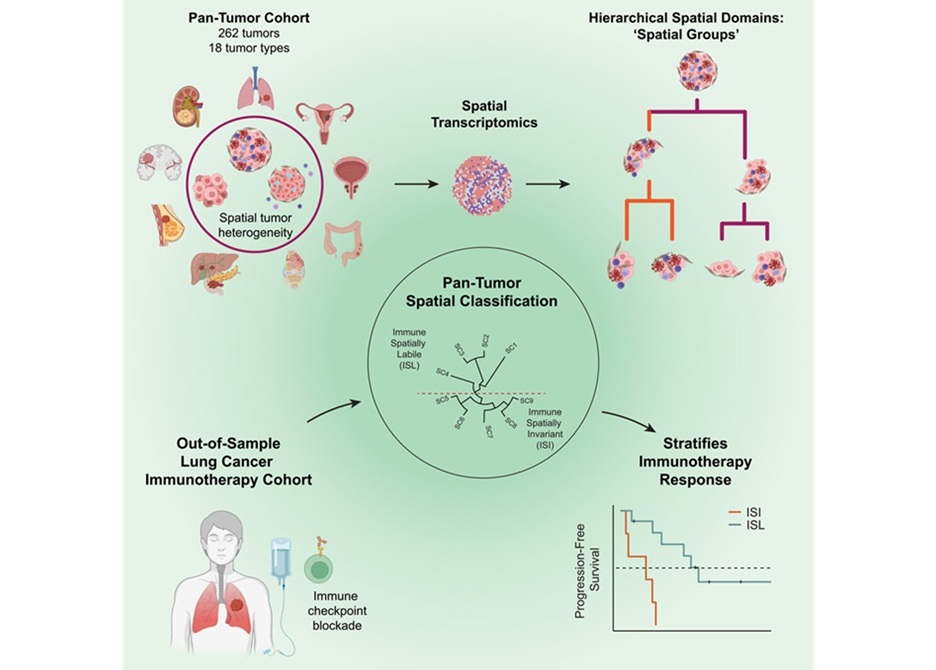
The team analyzed published spatial transcriptomic data from 262 solid tumors and derived statistical formulas describing how cells self-organize within the tumor microenvironment. These “floor plans” were then embedded into a comparative latent space, allowing analysts to calculate distance metrics and assess similarity between cases. The framework provides a common language for examining emergent spatial structure across diverse tumor types.
To assess clinical relevance, a lung cancer laboratory at the University of Chicago contributed 16 non-small cell lung cancer (NSCLC) tumor samples linked to immunotherapy outcomes. When tumors were compared by spatial groups within the latent space, the approach identified which NSCLC patients would respond to immunotherapy more accurately than the current standard-of-care biomarker. The authors indicate that the tools can be applied across tumor types and describe ongoing efforts to generate synthetic spatial classes, or canonical templates, for benchmarking by other researchers.
The study, “Pan-tumor spatial transcriptomics reveals conserved properties of tumor organization,” is published in Cell Reports Medicine on August 28, 2026. Ongoing collaborations within the University of Chicago are extending the framework to ovarian cancer to study responses to chemotherapy.
"The real promise of AI is that you can do things that humans can't do. It's not image generation or writing code and text. It's actually using it to do things that push the frontier forward," said Arjun Raman, M.D., Ph.D., assistant professor of pathology at UChicago and senior author of the new paper.
“As an oncologist, you will be greatly empowered with tools like this. You could have a person who comes in with their unicorn of a tumor. You then perform profiling on it, put the data into the comparative space, and within a few hours you can see if they should or should not get regimen X. That would be the dream one day, where you have precision oncology that isn't just a promise, but is manifest as an intersection of computational theory, medicine, and biology,” added Raman.
Related Links
University of Chicago