AI-Enabled Biochip Detects microRNA Biomarkers in Minutes
Posted on 17 Apr 2026
Detecting circulating microRNAs, small RNA molecules linked to diverse diseases, is technically challenging because they are scarce and often share similar sequences. Conventional workflows based on PCR can take hours and demand complex preparation, limiting throughput in clinical laboratories. Faster, multiplexed assays could strengthen biomarker measurement for oncology and other specialties. A new study shows that an artificial intelligence–enabled nanophotonic biochip can identify multiple microRNA targets in about 20 minutes.
Researchers at Nanyang Technological University (NTU Singapore), developed a biosensing platform that marries a specially designed nanophotonic chip with AI-automated image analysis. With a small drop of blood loaded into the chip, the system images thousands of microRNA signals in a single snapshot, enabling rapid, multiplex readouts. The work is published in Advanced Materials.
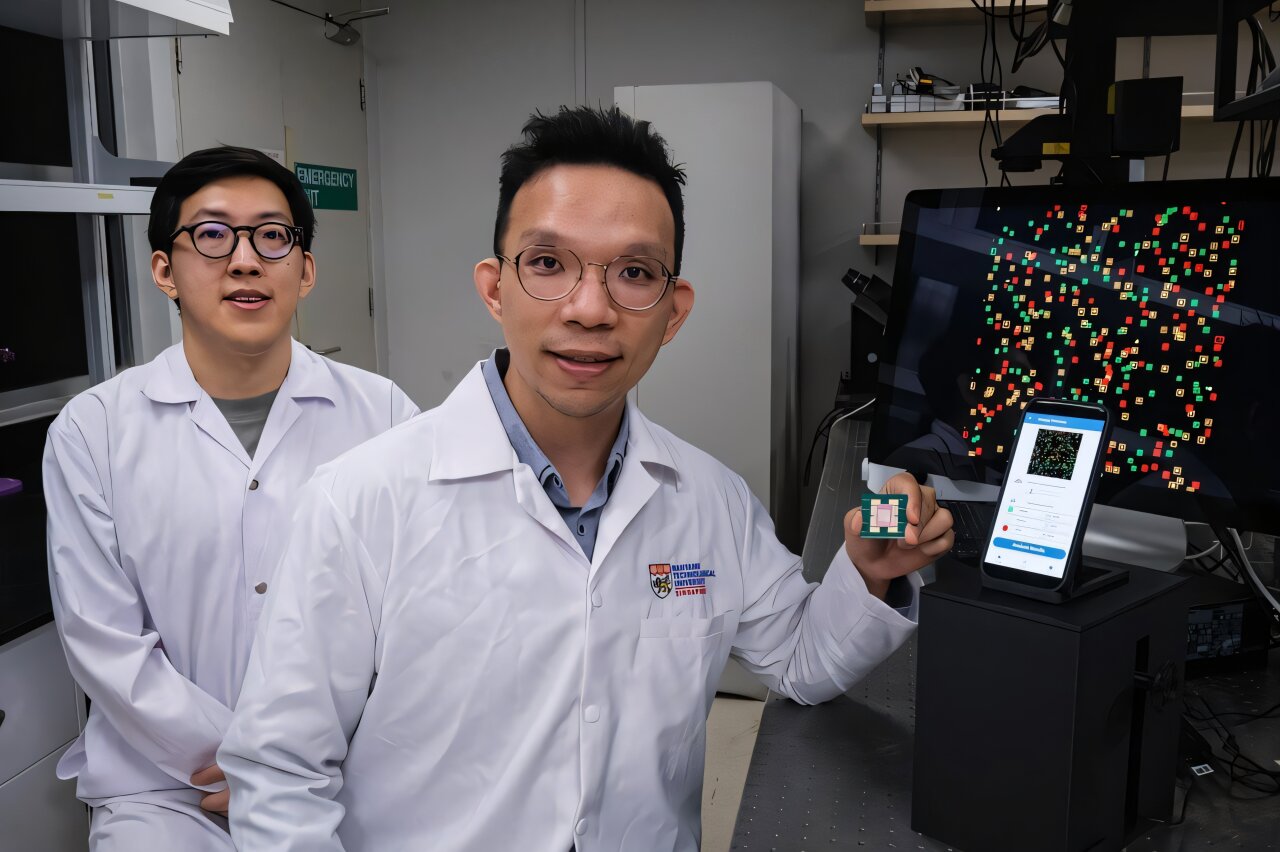
The platform’s core is a light-trapping “nanocavity,” a structure hundreds of times smaller than a human hair that reflects and amplifies fluorescence when a target microRNA binds to its matching probe. An automated imaging workflow captures signals in one shot. A deep-learning model known as Mask R-CNN then identifies and classifies fluorescent events by microRNA type, removing the need for manual counting and reducing operator error.
In testing, the system measured three microRNAs associated with non-small cell lung cancer—miR-191, miR-25, and miR-130a—from human lung cancer cell extracts without nucleic acid amplification or complex sample preparation. It also performed well when synthetic microRNAs were spiked into biological extracts, indicating robustness in more realistic matrices. Compared with polymerase chain reaction, the approach shortened analysis from hours to approximately 20 minutes.
According to the team, the platform detected targets at extremely low concentrations, down to a few molecules in a sample, and achieved more than 99% accuracy in identifying microRNAs across different test channels. The researchers built a compact prototype featuring a color camera to image the chip and a mobile phone application that uses AI algorithms to analyze microRNA signals and return rapid results.
“Our goal was to create a platform that can directly measure multiple microRNAs with very high sensitivity and at high throughput. By combining nanophotonic signal enhancement with AI-based image analysis, we were able to detect tiny amounts of RNA molecules across thousands of nanocavities within minutes,” said Bowen Fu, Ph.D. student at NTU’s Institute for Digital Molecular Analytics and Science (IDMxS).
"Our successful tests with lung cancer cells show that, with the right probes targeting different biomarkers, this technology could potentially be adapted for many other cancers and diseases, including cardiovascular and viral diseases," said NTU Associate Professor Chen Yu-Cheng, who led the study at the School of Electrical and Electronic Engineering.
Related Links
NTU Singapore




.jpg)