






Adsorption Procedure Enhances Efficiency of Drug Transport
By LabMedica International staff writers
Posted on 31 Jul 2018
A simple adsorption procedure enhances the efficiency of nanocarrier transport of toxic drugs to tumors.Posted on 31 Jul 2018
To promote drug delivery to exact sites and cell types, the surface of nanocarriers is functionalized with targeting antibodies or ligands, typically coupled by covalent chemistry. Once the nanocarrier is exposed to biological fluid such as plasma, however, its surface is inevitably covered with various biomolecules forming a protein corona, which masks the targeting ability of the nanoparticle.
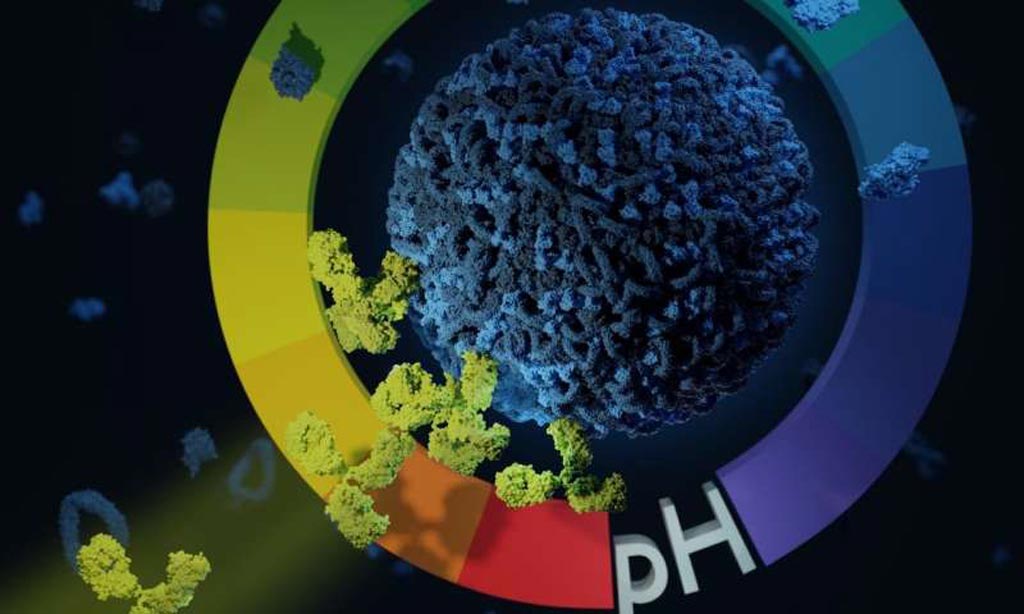
Image: Combining a nanocarrier with antibodies under acidic conditions results in the antibodies attaching to the drug carrier in a stable way. This makes it possible for nanocarriers to target diseased tissue (Photo courtesy of Stefan Schuhmacher).
To get around the protein-masking problem, investigators at Johannes Gutenberg University Mainz (Germany) developed a pre-adsorption process to attach targeting antibodies to the surface of the nanocarrier.
The investigators reported in the June 18, 2018, online edition of the journal Nature Nanotechnology that pre-adsorbed antibodies remained functional and were not completely exchanged or covered by the biomolecular corona, whereas coupled antibodies were more affected by this shielding.
"Up to now, we have always had to use elaborate chemical methods to bind these antibodies to nanocapsules," said senior author Dr. Volker Mailänder, head of the nanocarriers for medical applications group at the Johannes Gutenberg University Mainz. "We have now been able to show that all that you need to do is to combine antibodies and nanocapsules together in an acidified solution."
Related Links:
Johannes Gutenberg University Mainz




Platinum Member

Automated Coagulation Analyzer
Hemolumi H6
Gold Member

Quantitative POC Immunoassay Analyzer
EASY READER+

Gold Member

Platelet Function Analyzer
PL-12

Automatic CLIA Analyzer
Shine i6000


