Two Vitamin D Immunoassays Compared
By LabMedica International staff writers
Posted on 20 Aug 2019
Vitamin D can be synthesized in skin from 7-dehydrocholesterol following ultraviolet light exposure, which produces Vitamin D3 (cholecalciferol). Vitamin D2 (ergocalciferol) is present in plant sources, and can be absorbed from the diet.Posted on 20 Aug 2019
Measurement of 25-Hydroxyvitamin D (25-OH-D) is commonly performed to assess Vitamin D status in clinical laboratories; however, the ability of these assays to detect Vitamin D2 (as 25-OH-D2) or Vitamin D3 (as 25-OH-D3) varies. Assessment of Vitamin D status by measurement of 25-Hydroxyvitamin D (25-OH-D) is widely performed by immunoassay.
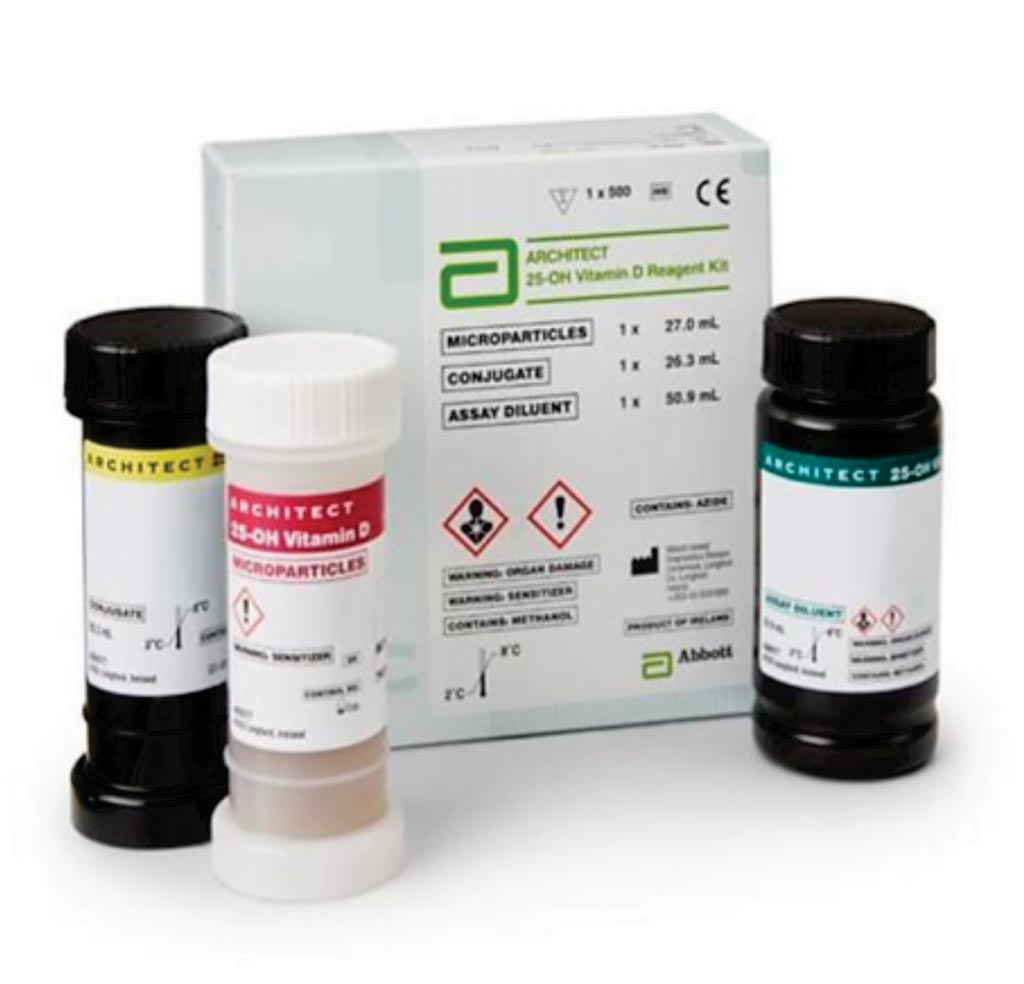
Image: The Architect 25-OH Vitamin D reagent kit (Photo courtesy of Abbott).
Biochemists at Baylor College of Medicine (Houston, TX, USA) and their colleagues evaluated the performance of the institution's total 25-OH-D assay on the Architect i1000 SR platform to detect either 25-OH-D2 or 25-OH-D3. This assay is a chemiluminescent microparticle immunoassay. Samples spiked with either 25-OH-D2 or 25-OH-D3 and reference laboratory samples with either 25-OH-D2 or 25-OH-D3 concentrations determined by liquid chromatography-tandem mass spectrometry (LC-MS/MS) were used for evaluation. As a comparison to the Architect assay, samples were also tested on the Cobas 8000, which uses an electrochemiluminescence binding assay.
The scientists reported that recovery of 25-OH-D3 in spiked samples was similar by Architect (84%–87%) and Cobas (90%). Recovery of 25-OH-D2 was lower than 25-OH-D3, and was poorer by Architect (37%–40%) than by Cobas (69%–71%). In measurement of samples with known 25-OH-D concentrations, performance of Architect and Cobas assays was similar for 25-OH-D3. However, at concentrations greater than 50 nmol/L 25-OH-D2, the Architect assay exhibited large average negative bias of −27%.
The authors concluded that while the Architect and Cobas assays performed similarly in detection of 25-OH-D3, the Architect assay was significantly poorer at detecting 25-OH-D2 than Cobas, with poorer recovery and significant negative bias at higher concentrations of 25-OH-D2. This agrees with other studies, and indicates that caution should be used in interpreting Architect 25-OH-D results in patients supplemented with Vitamin D2. The study was published on July 29, 2019, in the journal Practical Laboratory Medicine.




Platinum Member

Automated Coagulation Analyzer
Hemolumi H6
Gold Member

Electrolyte Analyzer
CBS-4000 (CBS-400)
New
Gold Member

Blood-Based Protein Biomarker Solution for Alzheimer's Disease
BG-DTi2000.

CMV CLIA Diagnostic
CLIA CMV IgA Screen Group